34 twists and braids for black men in 2026: the complete execution guide
I've watched twist and braid styles evolve over the past decade, and what's happening in 2026 is genuinely different. These aren't just aesthetic variations—they're functional hairstyles that work with real life: gym sessions, corporate environments, travel, and everything in between. The 34 dominant styles right now represent a sweet spot between cultural authenticity, low maintenance, and actual wearability.
why twists and braids matter in 2026
The resurgence of textured hairstyles among Black men isn't trendy nostalgia. It's practical. Unlike relaxed or chemically straightened hair, twists and braids work with your natural hair texture instead of against it. They reduce daily styling time, protect your edges during sleep, and honestly, they look intentional in a way that matters professionally and socially.
What's changed since 2020 is the precision. Stylists are tighter with their work. Parting patterns are more geometric. The aesthetic has moved away from purely casual into something you can wear to client meetings without a second thought.
the foundational styles: where everything starts
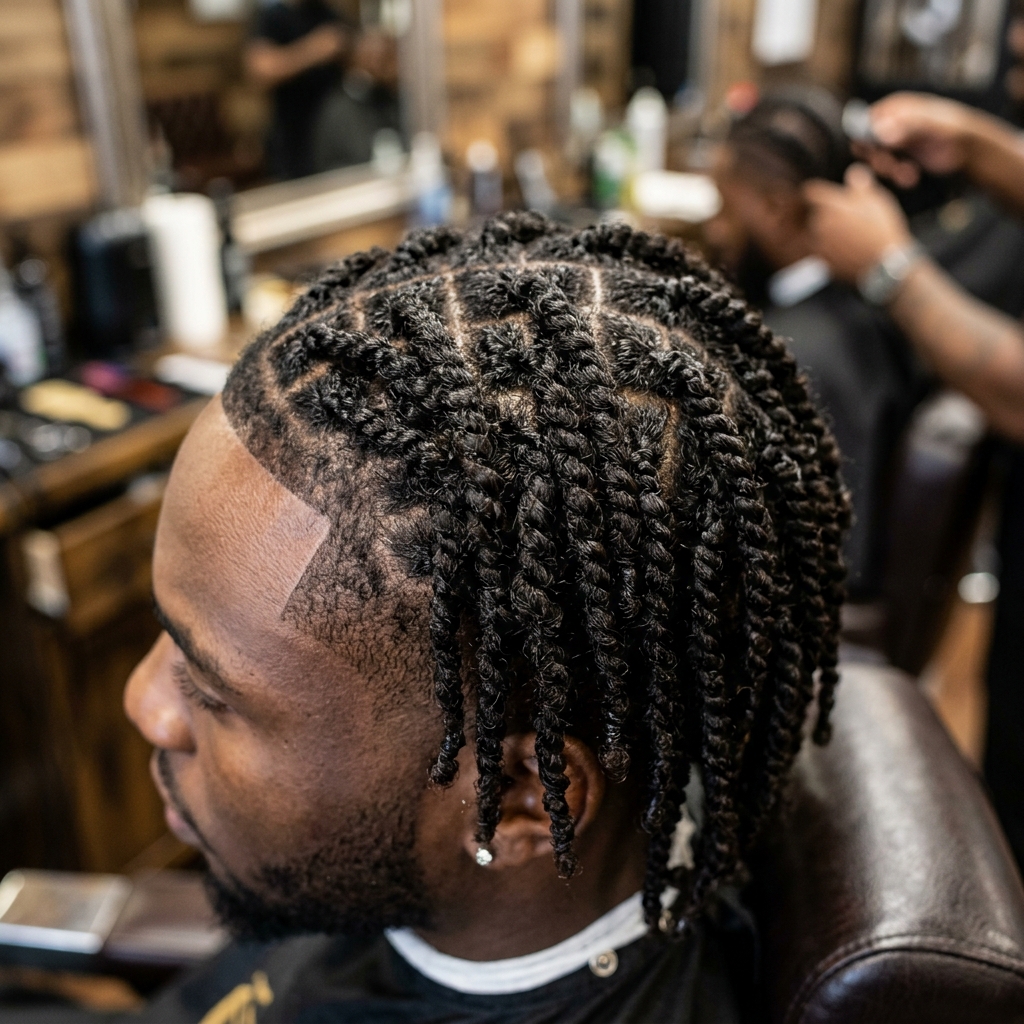
two-strand twists
Two-strand twists remain the baseline. Here's how they actually work: your stylist divides your hair into sections (typically quarter-inch to half-inch depending on desired thickness), then takes two strands from each section and wraps them around each other from root to tip. The tension matters. Too loose and they unravel in two weeks. Too tight and you're looking at breakage and traction alopecia along your hairline.
Most men in 2026 are getting twists that sit between a quarter-inch and three-eighths of an inch thick. Thicker twists (half-inch and up) read more casual; thinner twists look sharper. Installation takes 3-5 hours depending on hair length and density.
The maintenance game is real. You'll need to retwist every 4-6 weeks, or let them loc up intentionally if that's your direction. The cost runs $80-150 for installation, $50-80 for retwists.
box braids
Box braids are the workhorse style. Individual braids sit in square sections, hence the name. The geometry is what makes them look intentional. A good box braid installation uses synthetic hair (usually Kanekalon, which costs $3-8 per pack) or human hair extensions if you're going that route.
The braid size matters for your face shape and lifestyle. Smaller braids (quarter-inch) take 6-8 hours and last 8-10 weeks. Larger braids (half-inch to three-quarter-inch) take 3-4 hours and last 6-8 weeks. Paradoxically, larger braids are easier to maintain because there's less hair to manage.
In 2026, the trend is toward medium braids with clean, tight parting patterns. Zigzag parts, straight lines, geometric designs—these signal that you care about your appearance without looking like you're trying too hard.
cornrows
Cornrows are experiencing a legitimate renaissance. The style is ancient (we're talking thousands of years in West African cultures), but the execution in 2026 is cleaner than it's been in years. Cornrows are braids that sit flat against the scalp, created by adding hair as you braid from the root outward.
The parting patterns are where cornrows get interesting. Straight-back rows are classic and professional. But stylists are doing curved patterns, geometric designs, and even negative space work where the scalp shows between rows intentionally. Installation takes 2-4 hours depending on pattern complexity.
Cornrows last 4-6 weeks and require minimal maintenance beyond keeping them moisturized and protected at night with a silk or satin bonnet.
the mid-tier styles: where personality shows
loc'd twists and braids
This is where the 2026 aesthetic gets interesting. Loc'd twists are two-strand twists that you intentionally allow to mature into locs over 6-12 months. You're not maintaining them as twists—you're letting them fuse together naturally.
The difference between this and traditional locs is intentionality. You're starting with clean, defined twists and letting them progress. This gives you control over the final look in a way that free-form locs don't provide. Most men doing this are looking at a 12-18 month commitment before they have mature locs.
The advantage? You can reverse course at any point in the first few months if you change your mind. The disadvantage? That in-between phase (months 3-8) looks genuinely rough. Your twists will frizz, unravel slightly, and look unkempt. This is normal. It's also why many men don't stick with it.
faux locs
Faux locs are synthetic locs that you install on top of your natural hair. They're not permanent, which makes them attractive if you want the aesthetic without the commitment. Installation takes 4-6 hours, costs $150-250, and they last 6-8 weeks.
The catch? They're heavy. If you have fine hair or a sensitive scalp, faux locs can cause traction alopecia. If you're doing them, you need to take breaks between installations—at least 2-3 weeks between removal and reinstallation.
twisted mohawks
This is the style that works if you want something that reads immediately. Your sides are faded (typically a 1-2 guard clipper cut), and your center strip is twisted. The twists can be two-strand, three-strand, or even hybrid patterns.
The execution matters here. A good twisted mohawk has clean lines where the faded section meets the twisted section. Installation takes 2-3 hours. Maintenance is moderate—you'll need to retwist every 3-4 weeks and fade your sides every 2-3 weeks.
the advanced styles: technical execution
three-strand twists and braids
Three-strand work is where you start seeing real technical skill. Instead of two strands wrapping around each other, you're working with three strands that interlace. The visual result is tighter, more defined, and honestly more impressive looking.
The problem: installation time. Three-strand braids take 6-8 hours minimum. The cost reflects this—you're looking at $150-250 for installation. Retwists are $80-120.
Three-strand twists have a particular advantage: they hold better than two-strand twists because of the interlocking pattern. If you're someone who moves around a lot (sports, physical work), three-strand holds up better.
goddess braids
Goddess braids are a specific type of three-strand braid where the braid is thicker and more sculptural. The difference is in the technique—the stylist is adding hair as they braid, similar to cornrows, but the final braid sits away from the scalp rather than flat against it.
The aesthetic is intentionally bold. Goddess braids work best on men with medium to long hair (at least 6-8 inches). Installation takes 4-6 hours. They last 6-8 weeks.
feed-in braids
Feed-in braids are where precision really matters. The stylist starts with a small braid at the root using only your natural hair, then gradually adds synthetic hair as they braid down the length. The result is a braid that looks like it's growing from your scalp naturally.
This technique requires a skilled stylist. The parting has to be perfect. The tension has to be consistent. The feed-in has to be gradual and even. When it's done right, feed-in braids look significantly more polished than standard box braids.
Installation takes 5-7 hours. Cost is $150-250. They last 8-10 weeks.
maintenance protocols that actually work
Here's what I see most men get wrong: they install a style and then ignore it.
Moisture is non-negotiable. Twists and braids are protective styles, but they still need hydration. Use a lightweight leave-in conditioner (I'm partial to SheaMoisture Raw Shea Butter Restorative Conditioner or Carol's Daughter Black Vanilla Moisture & Shine) twice weekly. Spray it on, work it through with your fingers, and you're done.
Night protection matters. Sleep on a silk or satin pillowcase, or use a silk bonnet. Cotton pillowcases absorb moisture from your hair and create friction that causes frizz and breakage. This isn't optional if you want your style to last.
Retwisting frequency depends on your lifestyle. If you're working out regularly, sweating, or spending time in humidity, you'll need retwists every 3-4 weeks. If you're in a dry climate and low-activity, you can stretch to 6 weeks.
Scalp care is essential. Your scalp still needs to breathe. Use a clarifying shampoo every 2-3 weeks (Cantu Apple Cider Vinegar Clarifying Shampoo works) to remove product buildup and sweat. Massage your scalp with your fingertips for 5 minutes while shampooing.

the cost reality
Let's be honest about money. A quality installation runs $100-250 depending on style complexity and your location. Retwists run $50-150. If you're getting retwists every 4-6 weeks, you're looking at $400-900 per year in maintenance costs.
This is actually cheaper than many people think. A monthly haircut is $25-50, and you need them every 2-4 weeks. Twists and braids are a better value proposition over time.
The synthetic hair cost is real though. A full head of box braids uses 4-6 packs of synthetic hair at $3-8 per pack. If you're using human hair extensions, you're looking at $15-30 per pack and needing 6-8 packs.
which style works for your situation
If you work in corporate environments: Cornrows with clean geometric patterns, or medium-thickness box braids. Both read professional without looking costume-like. Avoid faux locs and anything with faded sides unless your workplace is genuinely casual.
If you're athletic: Three-strand twists or braids hold better than two-strand. Avoid styles that sit away from the scalp (like goddess braids) because they'll shift when you move. Keep them tight.
If you travel frequently: Box braids or cornrows. They're low-maintenance and survive plane rides, hotel pillows, and varying humidity levels. Avoid loc'd styles if you're traveling internationally—customs can be unpredictable about natural hair.
If you have fine or sensitive hair: Larger braids, fewer twists, and definitely take breaks between installations. Retwist every 6 weeks maximum, not 4. Consider getting your stylist to use lighter synthetic hair (Marley hair is lighter than Kanekalon).
If you want minimal maintenance: Cornrows or larger box braids. Smaller styles require more retwisting frequency. Loc'd twists require patience and acceptance of the awkward middle phase.
finding the right stylist
This matters more than you think. A bad installation ruins everything. A good stylist understands tension (tight enough to last, loose enough not to damage), parting geometry, and how to work with your specific hair type.
Ask for portfolio photos. Look at the edges—are they clean? Look at the roots—is the tension consistent? Look at the overall geometry—are the parts straight and even?
Expect to pay for quality. A $60 installation from someone learning the craft will disappoint you. A $150 installation from someone with 5+ years of experience will last longer and look better.
the practical takeaway
Twists and braids in 2026 are functional, professional, and genuinely low-maintenance compared to daily styling. The 34 dominant styles represent variations on core techniques—two-strand, three-strand, cornrows, and their combinations.
Pick a style that matches your lifestyle and maintenance tolerance. Find a skilled stylist. Commit to the moisture and night protection routine. Budget $400-900 annually for maintenance. That's the reality. It's not complicated, but it does require consistency.
The aesthetic payoff is real. You'll look intentional, your hair will be healthier, and you'll spend less time styling every morning. That's worth the investment.