25 black men's clothing styles for the modern gentleman: practical execution and maintenance
Black has stopped being a default and started being a choice. For men navigating professional environments, creative industries, and everything in between, black offers a legitimate aesthetic framework—not because it's "slimming" or a cop-out, but because it's architecturally honest. The challenge isn't wearing black. It's wearing black with intention.
I've spent the last decade watching men either nail this or botch it entirely. The difference comes down to understanding proportion, fabric weight, and when to break the monochrome rule. This isn't about looking like you're attending a funeral every day. It's about building a wardrobe that works.
why black works for modern men
Black absorbs light rather than reflects it. This matters more than fashion writers admit. In fluorescent office lighting, a well-fitted black shirt reads as intentional. In natural daylight, it can look flat if you don't understand layering and texture.
The practical advantage: stains disappear. Coffee spill on your black chinos at 10 AM? You're fine. This alone makes black functional for men who actually work rather than perform work on Instagram.
The psychological advantage: black creates visual weight at the bottom of an outfit, which is why it grounds silhouettes. A man in black trousers and a light shirt reads as more grounded than the inverse.
The maintenance advantage: black fades slower than any other color when you're washing in cold water and hanging to dry. We'll get into care later, but this is worth knowing upfront.
the five foundational black pieces
Before we discuss 25 styles, understand that everything branches from five core items.
Black crew neck t-shirt (heavyweight cotton, 6-7 oz)
Not the thin stuff from fast-fashion retailers. Uniqlo's Airism will disintegrate after 20 washes. Invest in Reiss or Sunspel. The weight matters because thin fabric clings and shows body contours in unflattering ways. Heavyweight cotton sits away from the body, drapes cleanly, and lasts three years of regular wear if you don't machine dry it.
Black oxford cloth button-down
This is different from a dress shirt. Oxford cloth has texture—a slight weave that catches light. It's more forgiving than poplin. Brooks Brothers makes the standard version. The point: it reads as less formal than a crisp white dress shirt, which means you can wear it to a casual dinner without looking like you're about to give a presentation.
Black chinos (flat front, mid-weight cotton blend)
Not denim. Not dress trousers. Chinos bridge the gap. Look for a 98% cotton / 2% elastane blend—the elastane prevents that stiff, cardboard feeling. The fit should be straight or slightly tapered, with a 15-16 inch opening at the hem. Measure this. Most men buy chinos too wide in the leg.
Black wool blazer (unstructured or semi-structured)
This is where fabric weight becomes critical. A 350-400 gsm wool blazer will drape properly without looking like armor. Structured blazers are for men who need to project authority in a boardroom. Unstructured blazers work everywhere else. The shoulders should sit right at your shoulder point—not extended, not pinched.
Black leather Chelsea boots or derby shoes
One or both. Chelsea boots work with everything from jeans to dress trousers. Derbies are slightly more formal. Both need to be genuine leather (not bonded leather, which flakes), with a proper leather sole that you can have resoled. Expect to spend $200-400 on something that lasts five years.
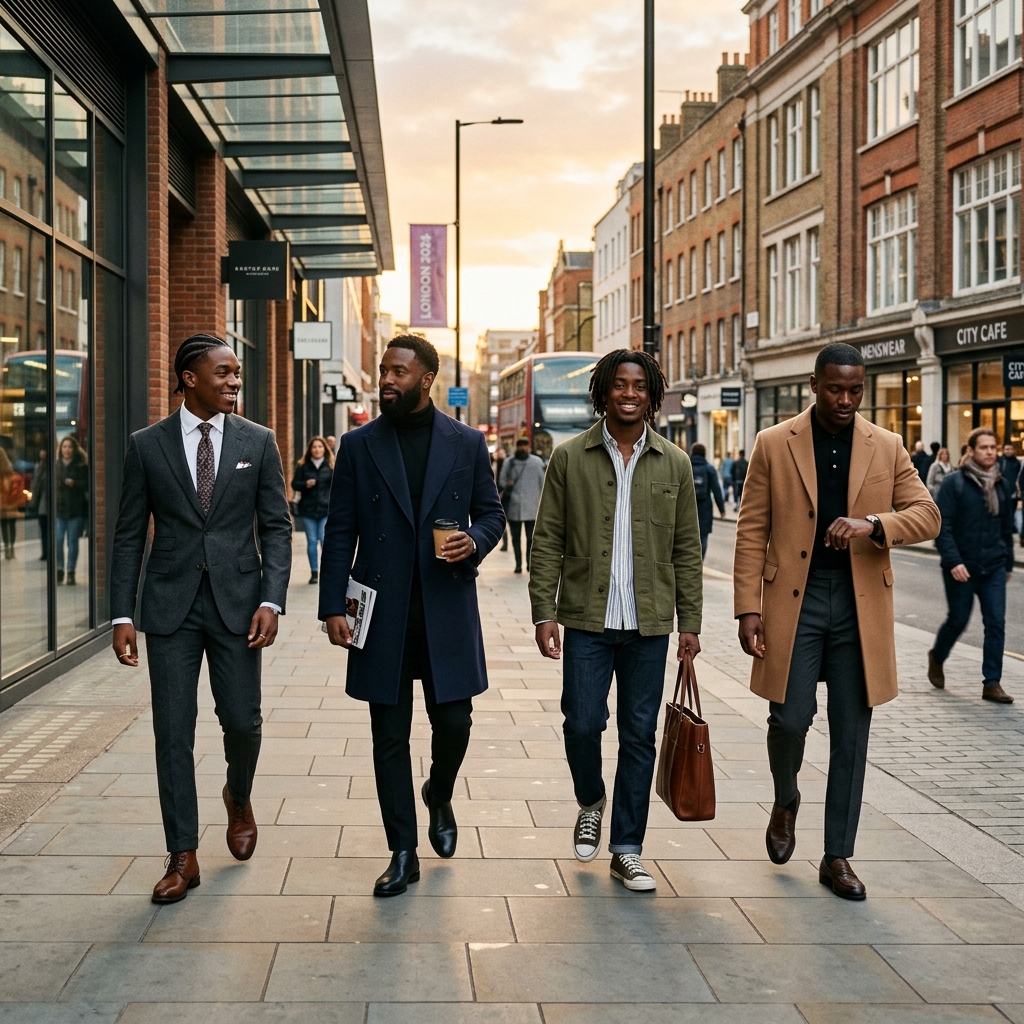
25 black clothing styles broken down by context
professional and business contexts (8 styles)
1. Black suit, white dress shirt, black tie
The uniform. Wear it when you need to signal competence without personality. The fit matters obsessively here. The jacket should button at your natural waist, with the lapels sitting flat. Trousers should break slightly on your shoe—about half an inch of fabric folding onto the top of your shoe. This requires tailoring. Accept this cost.
2. Black suit, light blue oxford, no tie
Slightly less formal. The light blue adds visual interest without being loud. This works for client meetings where you want to seem approachable.
3. Black blazer, white dress shirt, charcoal trousers
Not a suit. The blazer and trousers don't match, which is the point. This reads as more creative than a matched suit. It works in marketing, design, and any field where rigid formality signals inflexibility.
4. Black turtleneck, black trousers, black shoes
Monochromatic. This only works if every piece fits properly. A loose turtleneck will make you look like you're wearing a costume. The turtleneck should be snug but not suffocating. Layer a lightweight black merino wool sweater under a white shirt if you want the turtleneck effect without committing to it.
5. Black crew neck sweater, white dress shirt (collar visible), black chinos
The white collar showing underneath creates visual interest and breaks the monotony. This is a genuinely useful outfit for video calls or casual client meetings.
6. Black mock neck sweater, black trousers, brown leather shoes
The brown shoes are the break. They warm up the outfit and add dimension. This works better than you'd think for business casual environments.
7. Black cardigan, white t-shirt underneath, black trousers
Layers create texture. The white t-shirt peeks out and prevents the outfit from reading as funeral wear. This is practical for offices where you adjust temperature throughout the day.
8. Black dress shirt, black suit trousers, black shoes, minimal jewelry
High-fashion formal. This reads as confident, not goth. The key is fit. Everything must be tailored. A dress shirt should have a 2-3 inch gap between your neck and the collar when buttoned—not choking, not loose.
casual and weekend contexts (10 styles)
9. Black crew neck t-shirt, black jeans, white sneakers
The white sneakers are essential. They break the visual weight and add lightness. Without them, you look like you're heading to a dive bar at midnight.
10. Black hoodie, black chinos, black leather shoes
Functional and intentional. The hoodie should fit close to the body—not oversized. Oversized hoodies read as either athletic wear or depression wear.
11. Black t-shirt, medium-wash jeans, black leather Chelsea boots
The medium-wash jeans are the move here. They're lighter than black denim, which prevents the all-black bottom half. This is genuinely wearable for weekend errands.
12. Black long-sleeve henley, black chinos, tan suede sneakers
The tan suede sneakers warm everything up. Henleys are underrated—they have more visual interest than plain t-shirts without being busy.
13. Black overshirt (unstructured), white t-shirt, black jeans, white sneakers
An overshirt is a shirt worn as a jacket. It's looser than a traditional shirt, meant to layer over something else. This works for transitional weather and adds dimension.
14. Black crew neck sweatshirt, black joggers, black and white leather sneakers
Athleisure that doesn't scream gym. The key is fabric weight—a 300+ gsm sweatshirt that doesn't look thin and cheap. Avoid the ultra-tapered jogger silhouette; straight leg works better on most men.
15. Black camp collar shirt (short sleeve), black shorts, black leather sandals
Summer black. The camp collar (Cuban collar) adds visual interest. Shorts should hit just above the knee. Leather sandals should be substantial—not flip-flops.
16. Black linen shirt, black linen shorts, brown leather loafers
Linen wrinkles. Accept this. The wrinkles are part of the aesthetic. This works for warm-weather travel or casual weekends.
17. Black crew neck t-shirt, black cargo pants, black boots
Cargo pants are functional. Make sure they fit close to the body—not oversized. The cargo pockets should be subtle, not massive.
18. Black baseball tee (black body, black sleeves), black jeans, black sneakers
Vintage-inspired. This works if the baseball tee actually has some age to it or is made to look that way. New baseball tees read as costume.
seasonal and layering approaches (4 styles)
19. Black wool coat, black suit, white dress shirt
A proper wool coat—not a puffer jacket. Wool breathes and lasts decades if cared for. The coat should hit mid-thigh. Anything longer reads as costume.
20. Black quilted gilet, black crew neck sweater, black jeans
Layering for mild cold. The gilet adds texture without bulk. Make sure it's fitted, not oversized.
21. Black rain jacket, black chinos, black shoes
Function over form, but it doesn't have to look bad. A well-fitted rain jacket in black is genuinely useful. Look for taped seams and a hood that doesn't swallow your head.
22. Black turtleneck, black wool trousers, black overcoat, black leather gloves
Winter formal. The gloves matter—they complete the silhouette. Leather gloves should fit snugly without restricting movement.
texture and pattern breaking (3 styles)
23. Black crew neck t-shirt, black jeans, black and white Adidas sneakers
The white stripe on the sneakers breaks the monotony. This is simple and works.
24. Black sweater, black chinos, black shoes, silver watch
Jewelry as a break. A simple silver watch or bracelet adds visual interest without being loud.
25. Black polo shirt, black chinos, black leather shoes, subtle pattern socks (visible)
The socks are the play. A subtle pattern—stripes, small geometric—visible above the shoe adds personality. This works for business casual environments where you can push slightly.

fabric maintenance: keeping black looking new
Black fades. Accept this. But you can slow it significantly.
washing: Cold water only. Warm water opens the fiber and releases dye. Wash inside out. Use a detergent designed for dark fabrics—Woolite Dark or The Laundress Delicate Wash. Skip fabric softener; it builds up and dulls the fabric.
drying: Hang dry everything. Machine drying creates friction that fades fabric and creates pilling. A clothesline or drying rack takes 24 hours. Plan accordingly.
storage: Fold rather than hang heavy items like sweaters. Hanging stretches the shoulders. Store in a cool, dry place away from direct sunlight.
pilling: Use a fabric comb or sweater stone to remove pills. Don't pull them off with your fingers—you'll damage the fibers.
leather care: Condition leather shoes and boots every 6-8 months with a quality conditioner. This prevents cracking and keeps the leather supple. Use shoe trees to maintain shape.
fit principles that matter more than trends
A well-fitting black t-shirt should have about 2 inches of ease at the chest—meaning if your chest measures 40 inches, the shirt measures 42 inches. Too tight looks desperate. Too loose looks sloppy.
Black trousers should sit at your natural waist, not your hips. This is where most men go wrong. Your natural waist is where your body bends when you sit, typically 1-2 inches above your hip bones.
Sleeves on jackets and shirts should end at your wrist bone, not your hand. This requires tailoring for most men.
The inseam on trousers should create a slight break on your shoe—about half an inch of fabric folding. Full break (more fabric) reads as dated. No break (cropped) reads as intentional but requires confidence.
final thoughts: black as a framework, not a limitation
Black works because it's honest. It doesn't pretend to be something it's not. It doesn't chase trends. It sits in the background and lets your posture, your grooming, and your presence do the talking.
The men who wear black best aren't the ones trying to look cool. They're the ones who've understood that consistency in a color palette means you can focus on fit, fabric, and the actual work you're doing. That's the modern gentleman approach: less performance, more substance.
Start with the five foundational pieces. Build from there. Get things tailored. Wash in cold water. Hang dry. In two years, you'll have a wardrobe that actually works.