25 casual shorts outfit ideas for men: practical styling from fabric to fit
Shorts have spent the last decade fighting for legitimacy in men's fashion. For years, they were either gym wear or vacation wear—nothing in between. That's changed. The shift happened quietly, driven by remote work, warmer climates, and a generation of men finally comfortable dressing for their actual lives instead of some imagined office standard.
But here's what I've learned writing about men's style for fifteen years: most shorts advice is useless. People throw together outfit formulas without explaining why they work, how fabrics behave, or what actually happens when you wear these combinations for eight hours in real weather. This article fixes that.
Why shorts fit matters more than most men realize
The fit of shorts determines everything that follows. I'm not talking about fashion rules—I'm talking about basic physics and how your body moves.
Shorts should break just above the knee. This isn't arbitrary. When the inseam sits too long, it creates a visual anchor point that shortens your leg line and makes you look like you're wearing your dad's clothes from 1997. When it's too short (more than two inches above the knee), you're either a teenager or you're trying too hard.
For most men, this means an inseam between 7 and 9 inches. I know that's specific, but it matters. If you're under 5'9", stick to 7 inches. If you're 5'9" to 6'2", 8 inches works. Taller than that, 9 inches. This isn't a suggestion—it's geometry.
The waist should sit at your actual waist, not your hips. I see men constantly buying shorts that sag because they're afraid of something fitting properly. Shorts that sit on your hips look sloppy and require constant adjustment. Your shorts should feel secure enough that you forget you're wearing them.
Thigh openness matters too. Most casual shorts have a thigh opening between 6.5 and 8 inches. Anything wider and you're showing too much leg; anything narrower and you're restricting movement. The sweet spot lets you sit comfortably without the fabric riding up or bunching.
Fabric selection: the foundation of every outfit
Cotton-based shorts dominate casual wear for a reason—they breathe, they're affordable, and they're durable. But not all cotton is equal.
Oxford cloth shorts (like those from J.Crew or Banana Republic) have a textured weave that hides wrinkles better than plain cotton. They're heavier, which means they hold their shape. The downside: they take longer to dry and can feel stiff until washed several times. I wear these for work-adjacent casual situations.
Chino shorts remain the most versatile option. They're made from combed cotton twill, which is smoother than oxford but still structured. A good chino short in khaki, navy, or olive will work with nearly everything in your closet. The fit varies wildly between brands—Bonobos' chinos fit differently than Banana Republic's, which fit differently than J.Crew's. You need to try them on.
Linen and linen-blend shorts are increasingly common, and I understand why. Pure linen breathes beautifully and looks intentional. The problem: linen wrinkles aggressively and requires ironing or steaming. A 55% linen / 45% cotton blend gives you most of the breathability with less maintenance. Budget for ironing time if you go this route.
Performance fabrics (nylon blends, synthetic materials) have improved dramatically. Brands like Outlier and Reiss make shorts from technical fabrics that dry quickly, resist wrinkles, and move with your body. They cost more, but they require minimal maintenance. These are practical for travel or warm climates where you're changing clothes frequently.
25 outfit combinations that actually work
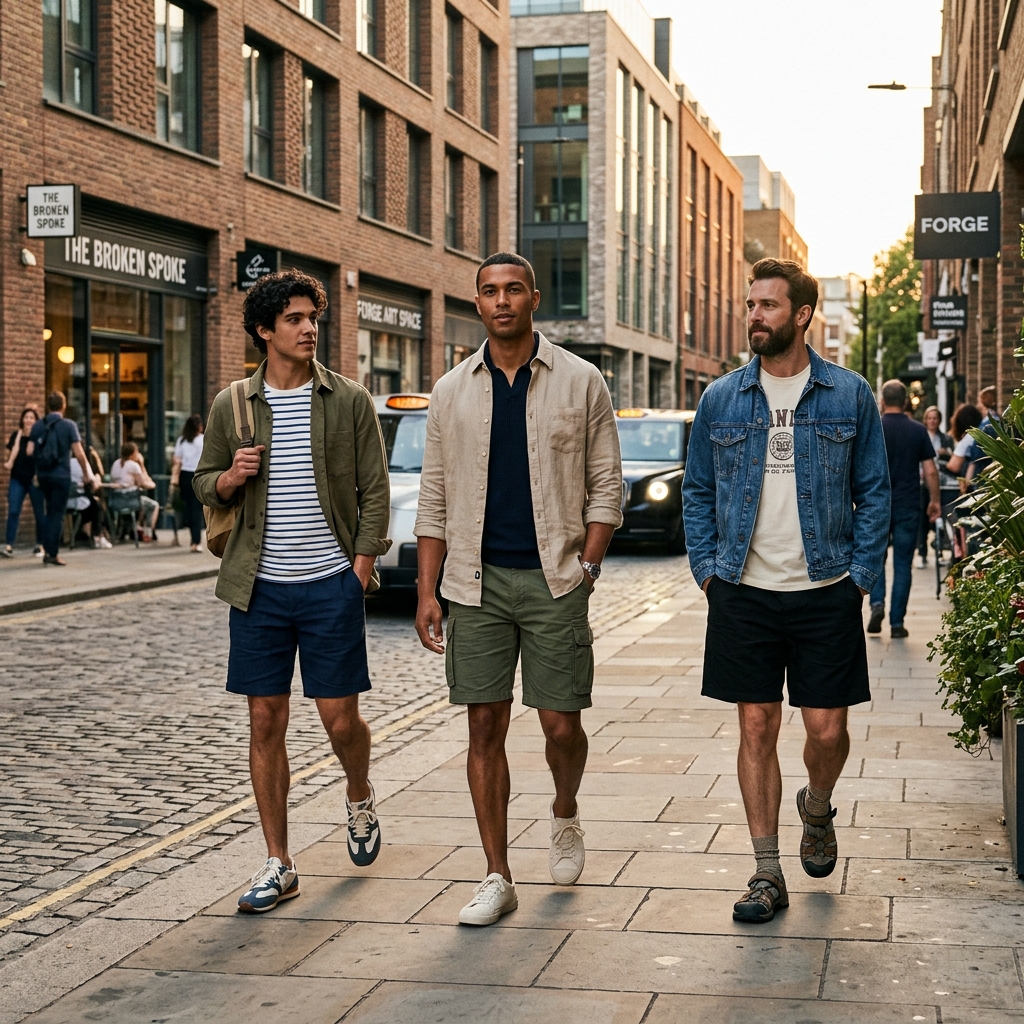
I'm not giving you aspirational nonsense here. These combinations assume you're wearing shorts to real places: work (if casual), coffee shops, running errands, casual dinners, weekend activities.
The neutral foundation (1-5)
Khaki chino shorts + white linen shirt + brown leather belt + white leather sneakers. This is the baseline. It works because there's no contrast fighting for attention. The linen shirt adds texture without complexity. Wear this when you're not sure what to wear.
Navy chino shorts + light blue oxford cloth shirt (sleeves rolled) + brown suede loafers + no socks. The color proximity (navy to light blue) is intentional—it creates harmony without looking matchy. This works for casual business settings that allow shorts.
Olive chino shorts + cream linen shirt + tan canvas belt + white canvas sneakers. Olive is underrated. It's neutral enough to pair with warm tones but interesting enough that you don't look boring.
Charcoal chino shorts + white t-shirt + black leather belt + black and white sneakers. Monochromatic dressing with shorts requires restraint. The sneakers provide the only visual break.
Khaki shorts + pale yellow oxford cloth shirt + brown leather belt + tan suede loafers. Yellow reads as preppy, but pale yellow is softer. This works for summer events where you want to look put-together without trying too hard.
The textured approach (6-10)
Navy shorts + cream cable-knit polo + brown leather belt + white leather sneakers. The texture of the polo adds dimension. This is slightly dressier than a regular polo because of the knit structure.
Khaki shorts + burgundy linen shirt + brown suede belt + brown leather loafers. Burgundy is a color most men avoid with shorts, which is a mistake. It's warm and works well in late spring and early fall.
Olive shorts + rust-colored linen shirt + tan canvas belt + brown suede sneakers. Rust and olive are earth tones that feel natural together. This combination works well for outdoor activities or casual weekend plans.
Navy shorts + striped linen shirt (navy and white) + brown leather belt + white canvas sneakers. Stripes add visual interest without being loud. The stripes should be thin (quarter-inch) not wide.
Charcoal shorts + cream waffle-knit henley + black leather belt + gray suede sneakers. The waffle knit texture is subtle but noticeable. This works for cooler days when you want something between a t-shirt and a full shirt.
The pattern integration (11-15)
Khaki shorts + navy and white gingham shirt + brown leather belt + white leather sneakers. Gingham is structured enough that it doesn't read as "trying too hard." Keep the pattern small-scale (quarter-inch check).
Navy shorts + cream shirt with small blue pattern + brown leather belt + brown leather loafers. The pattern should be small and subtle. Large patterns with shorts look costume-like.
Olive shorts + cream linen shirt with subtle texture + brown suede belt + tan suede loafers. Texture (not print) is safer than actual patterns if you're uncertain.
Khaki shorts + white shirt with fine blue stripes + brown leather belt + blue suede sneakers. The blue in the stripes echoes in the sneaker color, creating cohesion.
Charcoal shorts + cream shirt with small navy pattern + black leather belt + black leather sneakers. Keep patterns minimal with darker shorts. The outfit should feel balanced, not busy.
The casual-but-intentional approach (16-20)
Khaki shorts + plain white t-shirt + brown leather belt + brown suede loafers. Sometimes simplicity is the answer. This works because each piece is high-quality and fits properly.
Navy shorts + vintage-looking graphic t-shirt (faded, not bright) + brown canvas belt + white canvas sneakers. If you're wearing a graphic tee, keep it understated. Faded prints are more wearable than bright ones.
Olive shorts + cream henley + brown leather belt + tan leather sneakers. The henley sits between a t-shirt and a polo in formality. It's useful for layering or wearing alone.
Khaki shorts + light gray t-shirt + brown suede belt + gray suede sneakers. Monochromatic neutrals work because they're visually restful. This combination is nearly impossible to get wrong.
Navy shorts + white t-shirt + brown leather belt + brown leather loafers + white crew socks. White socks with shorts is acceptable when they're intentional and match your shirt. Avoid gray or black socks with shorts.
The warmer-weather options (21-25)
Khaki linen shorts + cream linen shirt + brown woven belt + brown leather sandals. Linen-on-linen works because the textures complement each other. This is your vacation outfit.
Navy shorts + white sleeveless shirt (tank or similar) + brown canvas belt + white canvas sneakers. Sleeveless shirts with shorts work in genuinely warm weather. Keep the shirt fitted, not oversized.
Olive shorts + cream linen shirt (unbuttoned over a white t-shirt) + tan canvas belt + white canvas sneakers. Layering a linen shirt over a t-shirt gives you flexibility as temperature changes.
Khaki shorts + pale blue linen shirt + brown leather belt + tan leather sandals. Sandals work with shorts when they're leather, not athletic. Avoid flip-flops unless you're at the beach.
Charcoal shorts + white linen shirt + black canvas belt + black and white canvas sneakers. This is your "I'm going out but it's casual" outfit. It works for casual dinners or evening activities.
Maintenance: keeping shorts looking intentional
Here's what nobody talks about: how you care for shorts determines how long they look good.
Wash shorts inside out in cold water. This protects the color and reduces fading. Dry them on low heat or air dry them—high heat damages the fibers and causes shrinkage. Most shorts will shrink slightly in the first wash, so account for that when buying.
For chino and oxford cloth shorts, a light iron or steamer keeps them looking crisp. Linen shorts need ironing if you care about wrinkles; if you don't, that's a valid aesthetic choice. Performance fabric shorts rarely need ironing.
Stains matter more on light-colored shorts. Treat stains immediately with cold water and a stain remover. Heat sets stains permanently, so avoid the dryer until you're certain the stain is gone.
The practical reality of shorts styling
Here's what I actually believe: shorts are easier to style than pants because there's less fabric to worry about. The formula is simple—fit matters most, fabric choice determines maintenance, and color coordination follows basic rules (neutrals with neutrals, warm tones with warm tones, cool tones with cool tones).
Most men overthink this. They buy shorts that don't fit properly, pair them with the wrong shoes, and then decide shorts don't work for them. The problem isn't shorts. It's execution.
Start with two pairs of well-fitting chino shorts in neutral colors (khaki and navy). Add white leather sneakers and brown leather loafers. Build from there. You don't need 25 outfits immediately—you need to understand how the pieces work together so you can build outfits yourself.
The best casual shorts outfit is the one you'll actually wear, that fits properly, and that makes you feel like yourself. Everything else is just details.