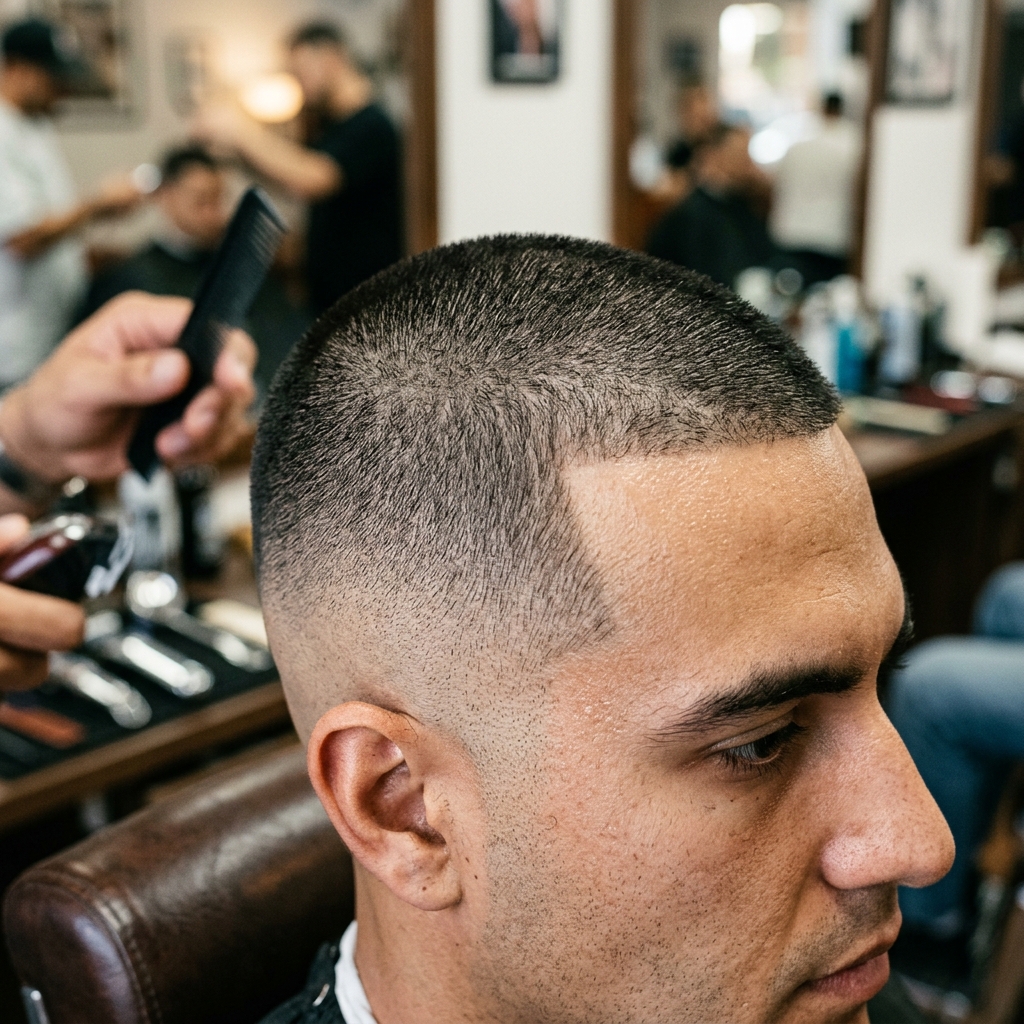
The buzz cut has survived every fashion cycle for nearly a century. It's not because it's trendy—it's because it works. I've watched men cycle through elaborate styles, only to return to the simplicity of clippers and a number guard. The appeal is straightforward: minimal upkeep, maximum control, and a silhouette that suits more face shapes than most realize.
But "buzz cut" isn't one thing. The variations matter. A 0.5 guard produces an entirely different effect than a 1.5 guard. Clipper lines, fade patterns, and how you handle the crown change everything. This article breaks down the actual execution, the history behind why this cut exists, and what you need to know to maintain it properly.
the practical anatomy of a buzz cut
A buzz cut is defined by one core principle: uniform length achieved with electric clippers. The clipper guard number directly corresponds to length in eighths of an inch. A number 1 guard equals 1/8 inch. A number 2 equals 1/4 inch. This matters because the difference between a 1 and a 1.5 is visible and changes how the cut reads on your head.
The scalp isn't flat. The crown is higher. The sides curve. A barber who understands this won't just run clippers in one direction. They'll work with the grain on the sides, against the grain on top, and adjust pressure based on how your hair grows. Pressure matters—too much and you'll get clipper burn. Too little and you'll leave uneven patches.
I've seen men buy home clipper kits expecting salon results. They don't understand that a professional barber is controlling blade angle, working in sections, and using their free hand to stretch the skin. If you're doing this at home, invest in a quality clipper set (Wahl, Andis, or Oster are reliable), use a mirror, and start with a longer guard. You can always go shorter. You can't go longer.
the 27 variations broken down by guard length and styling approach
Ultra-short buzz cuts (0.5 to 1 guard)
These are military-adjacent cuts. A 0.5 guard shows scalp. It's not quite a skin fade, but it's close. The 1 guard is the classic military buzz—barely any hair visible from a distance. Both require head shape confidence. If you have an irregular scalp or significant scarring, these expose it. But if your head is proportional, this cut reads clean and requires zero styling.
The high and tight is the most formal version: ultra-short sides with slightly longer hair on top (usually a 1.5 or 2 guard on the crown). This was standard military issue for decades. The contrast between sides and top creates definition without looking styled.
The butch cut sits here too—uniform length all around, typically a 1 guard, no fading. It's the most egalitarian buzz cut. No one's head looks better than anyone else's in a butch cut.
Short buzz cuts (1.5 to 2 guard)
This is where most men should start if they're new to buzz cuts. A 1.5 guard shows the shape of your hair without exposing scalp. A 2 guard is slightly fuller and more forgiving of growth between cuts.
The flat-top buzz emerged in the 1950s and had a resurgence in the 1990s. The top is cut flat (literally squared off), while sides are faded shorter. This requires precise clipper work and grows out awkwardly, but it photographs well and reads as intentional.
The crew cut is technically not a buzz cut—it has slightly longer hair on top that can be styled—but the buzz crew bridges the gap. It's a crew cut's silhouette with uniform length. No styling required, but enough hair to see texture.
The induction cut is what you get when you show up to basic training. Uniform 1.5 or 2 guard, no fading, no variation. It's functional and honest.
Medium buzz cuts (2.5 to 3.5 guard)
These cuts retain enough hair to show texture and color variation. They're less "military" and more "I chose this."
The textured buzz uses a 3 guard on top and fades the sides down to a 1 or 1.5. This creates dimension. If you have naturally textured or curly hair, this cut works exceptionally well because the texture does the work. You don't need to style it, but the cut itself has visual interest.
The taper buzz is similar but with a more gradual fade from top to sides. Instead of a hard line, the guard numbers progress: 3 on top, 2.5 mid-side, 1.5 at the edges. It's more sophisticated and requires a barber who understands fade work.
The skin fade buzz combines a buzz cut on top (typically 2 or 2.5 guard) with a fade that goes down to skin (0 guard) at the edges. The contrast is sharp. This is popular now and reads modern, but it requires maintenance every 2-3 weeks as the fade grows out.

Longer buzz cuts (3.5+ guard)
These blur the line between buzz cuts and short crops. They require more maintenance because longer hair shows every imperfection in the cut.
The buzz fade uses a longer guard on top (3.5 or 4) with a fade underneath. This is what happens when someone wants a buzz cut but also wants styling options. You can brush it forward, back, or leave it messy. It's versatile.
The textured crop buzz is essentially a buzz cut that's long enough to show individual hair strands. It requires a 4 guard minimum and works best on men with naturally wavy or curly hair. Straight hair can look thin at this length.
The disconnected buzz is a recent variation: a longer guard on top (3.5 to 4) with a completely disconnected fade (0 to 1 guard) underneath. The contrast is dramatic. It's not practical—the line between sections grows out visibly—but it's visually striking.
why the buzz cut exists: the actual history
The buzz cut wasn't invented for aesthetics. It was invented for efficiency and hygiene. In the 1940s, the U.S. military needed to process thousands of recruits quickly. Long hair required maintenance, harbored lice, and made helmet-wearing uncomfortable. Electric clippers solved all three problems in minutes.
The cut became so associated with military service that it signified discipline and conformity for decades. In the 1950s, it was the default for men. By the 1960s, longer hair became countercultural, and buzz cuts became the symbol of the establishment. By the 1980s, it was associated with skinheads and extremism in some contexts.
The buzz cut's reputation has rehabilitated significantly. It's now seen as practical rather than political. Soldiers still wear it. So do CEOs, athletes, and men who simply don't want to think about their hair. The practicality that created it remains its strongest argument.
maintenance: what you actually need to do
A buzz cut requires less maintenance than longer styles, but it's not zero maintenance.
Growth and regrowth timing
Hair grows approximately 0.5 inches per month. A 2 guard buzz cut becomes noticeably longer after 3-4 weeks. A 1 guard becomes noticeable after 2-3 weeks. If you want consistent appearance, plan for a cut every 2-4 weeks depending on your guard length and how much growth bothers you.
At-home maintenance
If you're maintaining your own buzz cut between professional cuts, use the same guard you started with. Run clippers in multiple directions: with the grain on sides, against the grain on top, and diagonal passes to catch missed sections. Use a handheld mirror to check the back. This takes 10 minutes and costs nothing after the initial clipper investment.
Clipper hygiene and blade maintenance
Clipper blades dull. A dull blade pulls hair instead of cutting it, causing irritation. Oil your blades after every use (most clippers come with blade oil). Replace blades every 6-12 months depending on use. A $15 blade replacement beats $30 clipper burn treatment.
Scalp care
Short hair exposes your scalp to sun. Use sunscreen on your head if you're outside regularly. A buzz cut also makes dandruff more visible. If you have a dry scalp, use a moisturizing shampoo. Your scalp needs less product than longer hair, but it needs something.
Styling products (if you want them)
A 2.5+ guard buzz cut can be styled slightly with a light pomade or clay. Apply to damp hair and brush backward or to the side. Most men with buzz cuts skip this entirely, which is fine. The cut's appeal is often its lack of required styling.
matching buzz cut variations to face shapes and hair types
Round faces
A round face benefits from a high and tight or skin fade buzz. The contrast between short sides and slightly longer top creates vertical lines that elongate the face. Avoid completely uniform cuts—they emphasize roundness.
Square faces
Square faces can handle any buzz cut variation. A flat-top buzz or disconnected buzz actually complements strong jawlines. The hard lines of the cut echo the face shape.
Oval faces
Oval faces are forgiving. Any variation works. If you're unsure, start with a crew buzz or textured buzz at a 2.5 guard.
Oblong faces
An oblong face needs width on top. A flat-top buzz or textured buzz with a 3+ guard on top and faded sides creates the illusion of width.
Straight hair
Straight hair looks best at shorter lengths (1 to 2.5 guard) because longer straight hair can appear thin. A skin fade or high and tight works well.
Curly or textured hair
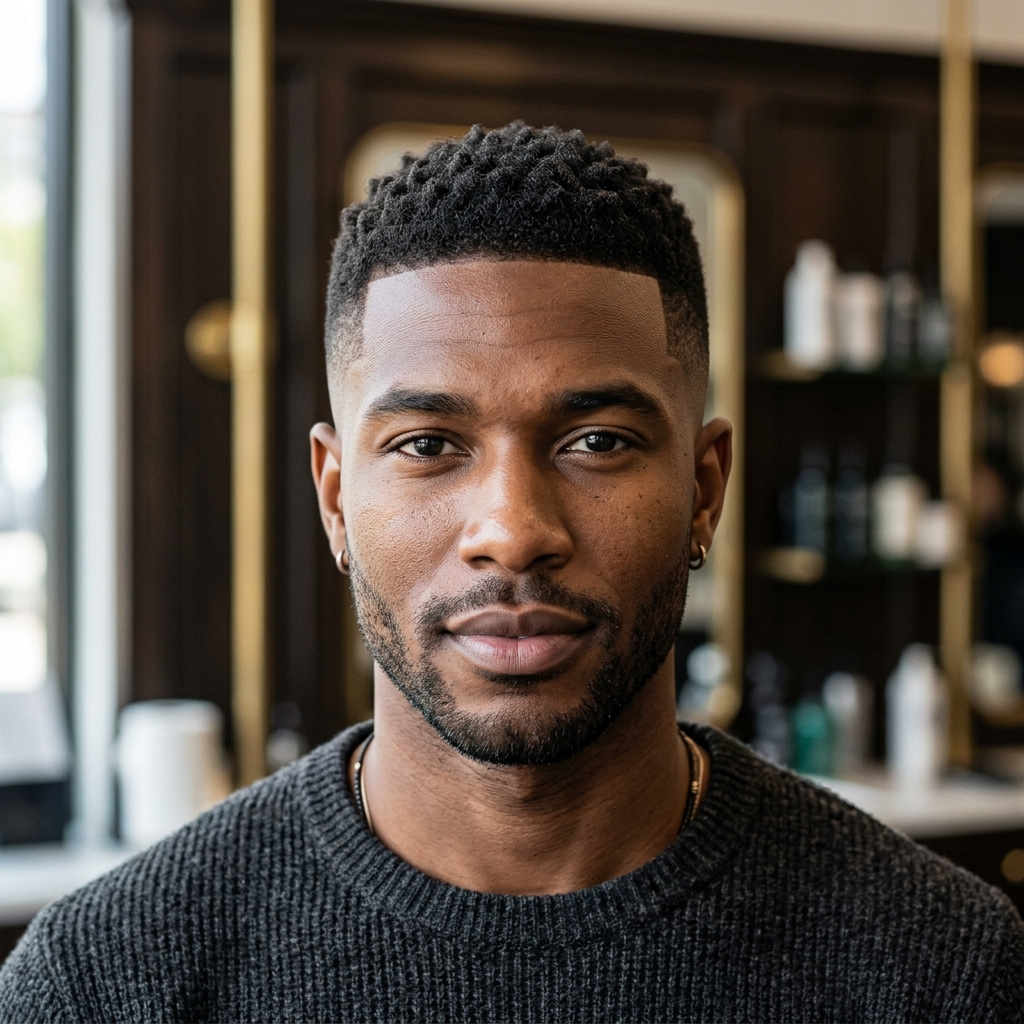
Curly hair is the exception where longer buzz cuts work beautifully. A 3 to 4 guard textured buzz or buzz fade shows off natural texture. The curl pattern does the visual work.
Thinning hair
If you're experiencing hair loss, a buzz cut is actually ideal. It removes the contrast between full and thin areas. A 1 to 1.5 guard shows confidence and is more flattering than attempting to hide thinning with length.
the practical reality: when a buzz cut makes sense
I'm not going to pretend a buzz cut is for everyone. It requires head shape confidence and comfort with minimal styling. But for men who value time over appearance tweaking, it's unbeatable.
A buzz cut makes sense if you:
- Spend more than 2 hours per week on hair care
- Have a regular gym or outdoor routine where hair gets sweaty
- Prefer not to think about your appearance
- Have a professional environment where neat appearance matters more than style
- Are experiencing early hair loss and want to own it
A buzz cut doesn't make sense if you:
- Have significant scalp scarring or irregular head shape you're self-conscious about
- Want styling flexibility
- Have very fine or very thin hair (it can look wispy)
- Live in a climate where scalp sun exposure is constant
final word
The buzz cut endures because it solves a real problem: how to look neat with minimal effort. The 27 variations I've outlined exist because men's heads, hair types, and preferences vary. There's no single "best" buzz cut. There's the right buzz cut for your head, your lifestyle, and your tolerance for maintenance.
If you're considering one, visit a barber who understands fades and clipper work. Show them a photo of the specific variation you want. Discuss your hair growth pattern and how often you're willing to get cuts. Then commit to the maintenance schedule. A buzz cut that grows out for 6 weeks looks worse than longer hair that grows out for 6 weeks.
Start with a 2 guard if you're new to this. You can always go shorter next time. That's the practical approach.