28 wedding outfit ideas for men in 2026: practical styling from ceremony to reception
Wedding season in 2026 demands something different from the tired playbook of previous years. The men I've dressed for weddings lately aren't interested in looking like they raided a rental shop—they want pieces that feel intentional, work with their actual body type, and transition smoothly from the ceremony into an evening of dancing without looking like they've changed costumes.
I've spent the last eighteen months studying what's actually working on grooms, groomsmen, and wedding guests. This isn't about trends that'll be dead by fall. It's about the specific mechanics of dressing well for a wedding in 2026, including what fabrics hold up under stress, which silhouettes photograph well, and how to maintain these outfits without professional cleaning after every wear.
understanding the 2026 wedding dress code landscape
The wedding dress code has fractured into something more honest. We're past the era where "black tie" meant one rigid interpretation. What I'm seeing now is a spectrum where formality exists on a sliding scale, and the best-dressed men are the ones who understand where their specific wedding sits on that spectrum and dress accordingly.
The traditional categories still exist—black tie, white tie, business formal, business casual, cocktail, and smart casual—but they're being interpreted with more flexibility. A black tie wedding in 2026 might welcome a navy dinner jacket. A business formal wedding might allow texture and pattern in ways that felt risky five years ago.
The key is reading the invitation language carefully. "Black tie optional" means something different than "black tie." The former gives you room; the latter doesn't.
the core 28 outfit frameworks
Rather than listing 28 completely different outfits (which would be impractical), I'm organizing these as modular systems. You can build multiple looks from fewer pieces, which is how actual men who dress well operate.
black tie and white tie foundations (6 outfits)
1. Classic black dinner jacket with silk-faced lapels, white dress shirt, black bow tie
This is non-negotiable for formal weddings. The silk-facing on the lapels catches light and photographs well. Your jacket should be 100% wool, single-breasted, with a peak or shawl lapel depending on your shoulder width. Peak lapels suit broader frames; shawl lapels work better on slighter builds.
The shirt needs to be 100% cotton with a 1.5-inch turnback cuff. Polyester blends wrinkle during the ceremony and look cheap in photos. Expect to pay $80-150 for a proper dress shirt.
2. Black dinner jacket with grosgrain-trimmed trousers and white piqué waistcoat
The waistcoat adds visual interest and allows you to remove the jacket during reception without looking underdressed. This setup works particularly well if you're a groomsman who'll be photographed extensively.
3. Navy dinner jacket with black trousers and burgundy bow tie
Navy reads as black in photographs but feels fresher in person. This combination works for less formal black tie events or second-day celebrations.
4. Charcoal dinner jacket with peak lapels, ivory shirt, and charcoal silk bow tie
For summer or destination weddings, charcoal is more forgiving than black. The ivory shirt provides contrast without feeling costume-like.
5. Double-breasted dinner jacket in black with satin lapels and high button stance
This requires a specific body type—you need a naturally slim torso and good posture. If you don't have this, skip it. A poorly fitted double-breasted jacket looks worse than a well-fitted single-breasted.
6. White tie: black tailcoat with white marcella shirt and white bow tie
White tie is rare now, but when it appears, there's no negotiation. Rent this if you don't own it. The tailcoat should have a 1.5-inch silk braid on the trouser leg and a 2-inch satin collar. Your shirt studs should be mother-of-pearl or platinum, never gold.
business formal and cocktail frameworks (8 outfits)
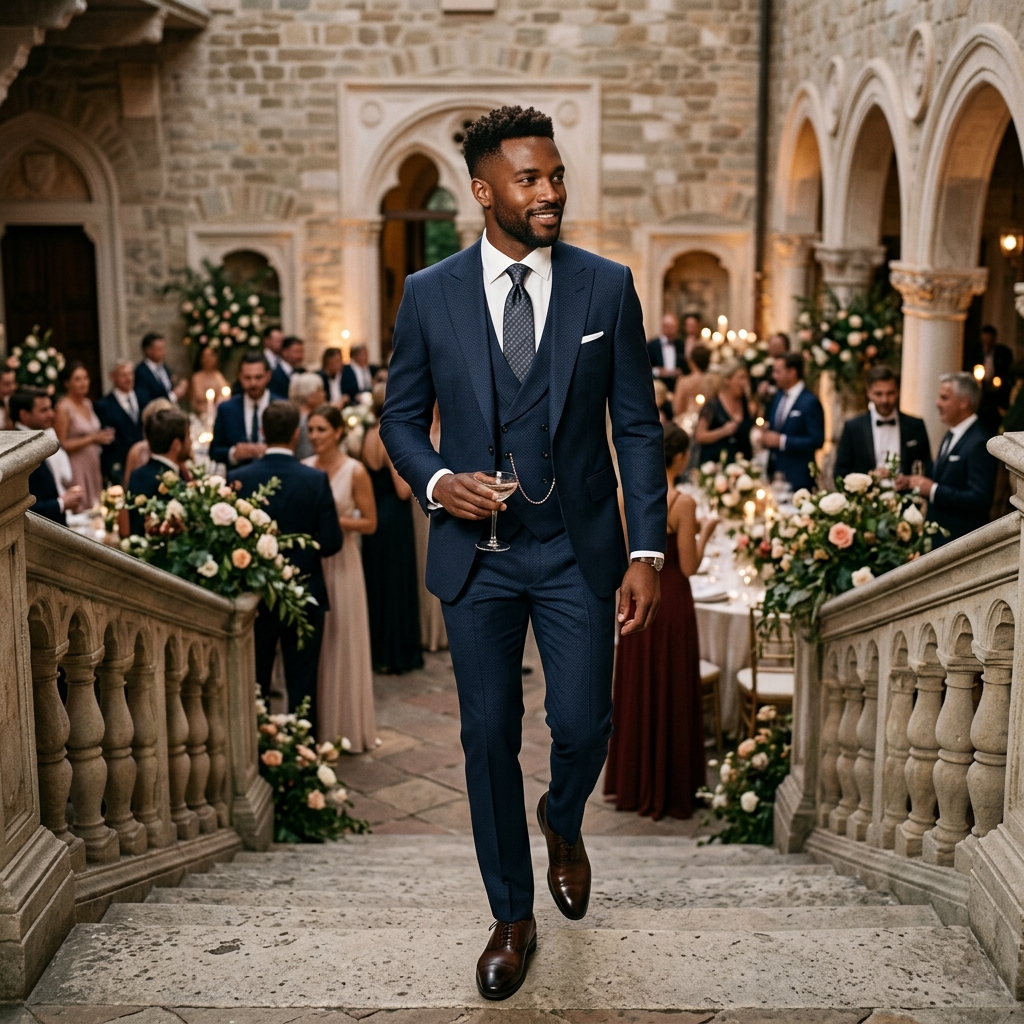
7. Navy blazer with subtle texture, white dress shirt, navy silk tie
This is your workhorse. The blazer should be 100% wool with a slight herringbone or pick weave—something that adds depth without screaming "pattern." The fit matters enormously: the jacket should skim your torso without clinging, with the bottom button sitting at your natural waist.
8. Charcoal blazer with peak lapels, light blue shirt, burgundy knit tie
Knit ties are having a moment because they feel less formal than silk while maintaining elegance. They're also easier to maintain—you can hand-wash them.
9. Navy blazer with windowpane pattern, cream shirt, navy tie with subtle texture
The windowpane needs to be subtle—think 1-inch squares, not bold checks. This works for late-afternoon or garden weddings.
10. Camel blazer (yes, really), white shirt, chocolate brown tie
Camel is underused and photographs beautifully. It works for destination weddings, outdoor ceremonies, and any event after 4 p.m. Pair it with navy trousers for maximum versatility.
11. Charcoal blazer, white shirt with subtle texture, pocket square in burgundy silk
Skip the tie entirely. A pocket square alone signals formality while feeling modern. This works for cocktail-hour-focused weddings.
12. Navy blazer with subtle sheen (wool-silk blend), pale pink shirt, navy tie
The sheen catches light without being obvious. This combination photographs exceptionally well under mixed indoor-outdoor lighting.
13. Taupe blazer, white dress shirt, taupe tie with tonal texture
Monochromatic dressing is harder than it looks, but when executed correctly, it reads as sophisticated rather than boring.
14. Slate blue blazer, white shirt, silver-grey tie with subtle diagonal weave
Slate blue is more interesting than navy while remaining conservative. It suits olive and deeper skin tones particularly well.
smart casual and garden wedding frameworks (8 outfits)
15. Unstructured linen blazer in natural, white linen shirt, no tie
Linen wrinkles—that's the point. The wrinkles should look intentional, not neglectful. Have the blazer tailored so it skims rather than drapes. Linen blazers need a t-shirt or tank underneath to prevent transparency.
16. Lightweight cotton blazer in sage green, white oxford cloth shirt, rolled sleeves
Rolled sleeves signal that you're not taking yourself too seriously while maintaining formality. Roll them to your mid-forearm, not your elbow.
17. Unstructured wool blazer in oatmeal, cream linen shirt, leather belt in cognac
This combination works for spring and early fall weddings. The oatmeal reads as neutral while feeling warmer than grey.
18. Cotton-linen blend blazer in light blue, white shirt, no tie, visible undershirt in cream
Layering a visible undershirt (not a t-shirt) under an unstructured blazer creates depth and formality without feeling overdressed.
19. Textured cotton blazer in warm grey, pale blue oxford shirt, suede loafers
Suede loafers are more interesting than leather for casual weddings. They need brushing after each wear to maintain the nap.
20. Unstructured blazer in taupe linen-cotton blend, white shirt, lightweight scarf in cream
Scarves work for destination or evening garden weddings. Keep it thin and tie it loosely.
21. Lightweight wool blazer in sage, cream shirt, brown leather belt, no tie
Sage is having a genuine moment in menswear because it photographs well and suits most skin tones.
22. Unstructured cotton blazer in sand, white linen shirt, straw pocket square
The straw pocket square is a nice detail that signals you've thought about the outfit.
trouser and bottom frameworks (4 outfits addressing fit specifically)
23. Flat-front trousers in 100% wool, charcoal, with a 16-inch hem opening
Flat-front trousers are standard now. The 16-inch hem opening works for most body types. Have them hemmed to break slightly on your shoe—roughly 0.5 inches of fabric touching the top of your shoe.
24. Pleated-front trousers in navy wool, 17-inch hem opening, for larger frames
Pleats aren't dead; they're just correctly proportioned now. One pleat per side, starting 2 inches from the waistband. They provide room without billowing.
25. High-waisted trousers in charcoal wool, 15-inch hem opening, for slighter builds
High-waisted trousers (sitting at your natural waist rather than your hips) elongate the leg and suit leaner frames. They require proper tailoring to sit correctly.
26. Wool-blend trousers with subtle texture (pick weave), navy, 16-inch hem opening
The texture adds visual interest in photographs without being loud.
27. Lightweight wool trousers in warm grey, flat-front, for summer weddings
Lightweight wool breathes better than cotton and drapes more elegantly. It costs more but holds its shape better throughout an evening.
28. Wool-linen blend trousers in taupe, flat-front, for destination or outdoor weddings
The linen blend prevents the heavy feeling of pure wool in warm weather while maintaining structure.
the practical mechanics of wedding dressing
Here's what actually matters when you're standing in a ceremony for 45 minutes and then dancing for four hours:
Fabric choice determines comfort. Wool blends that include 2-5% elastane (spandex) move with your body without feeling stretchy. 100% wool is fine if it's high-quality and properly tailored, but it can feel restrictive if you're not used to formal wear.
Shirt fit prevents disaster. The armhole should sit at your actual shoulder point, not two inches down your arm. The sleeve should end at your wrist bone, not your hand. If the shirt pulls across your chest when you sit, it's too small. You should be able to pinch an inch of fabric at the side seam when standing.
Jacket length matters for photographs. The jacket should cover your backside completely. The bottom button should sit at your natural waist. The sleeve should end at your wrist bone with roughly 0.5 inches of shirt cuff visible.
Trouser break affects the entire silhouette. A slight break (fabric just touching the shoe) looks modern and clean. No break (cropped above the shoe) works only if you have exceptional proportions and are wearing interesting shoes.
maintenance and longevity
Wedding clothes get worn once or twice yearly, which means they need proper storage.
Wool blazers should be hung on wooden hangers (plastic deforms the shoulders) in a cool, dry closet. Brush them with a soft-bristled clothes brush after each wear to remove dust and restore the nap. Dry cleaning should happen only once yearly or when truly necessary—the chemicals damage fibers over time.
Dress shirts need to be laundered after each wear. Hang them immediately after drying to prevent wrinkles. If you're wearing them multiple times (like a groomsman at multiple events), have at least three identical shirts so you're not wearing the same one within a week.
Trousers should be hung by the cuffs on a clip hanger. Press them only when necessary—excessive pressing breaks down the fibers. A steamer is gentler than an iron for touch-ups.
Bow ties and neckties should be rolled and stored flat, never hung. Silk ties develop creases that become permanent if hung for extended periods.
the actual shopping strategy
Don't buy 28 complete outfits. Buy three blazers (navy, charcoal, one interesting color), five dress shirts, four pairs of trousers, and rotate them. You'll look different in every combination while actually owning a reasonable wardrobe.
Invest in proper tailoring. A $150 blazer tailored for $80 looks better than a $400 blazer worn off-the-rack. Budget 30-40% of your clothing budget for alterations.
Buy shoes last. Once you know your complete outfit, choose shoes that complement it rather than trying to build outfits around shoes you already own.
The men I've seen look best at weddings in 2026 aren't wearing trend pieces. They're wearing well-fitted classics in quality fabrics, maintained properly, and worn with confidence. That's not revolutionary advice, but it's honest.