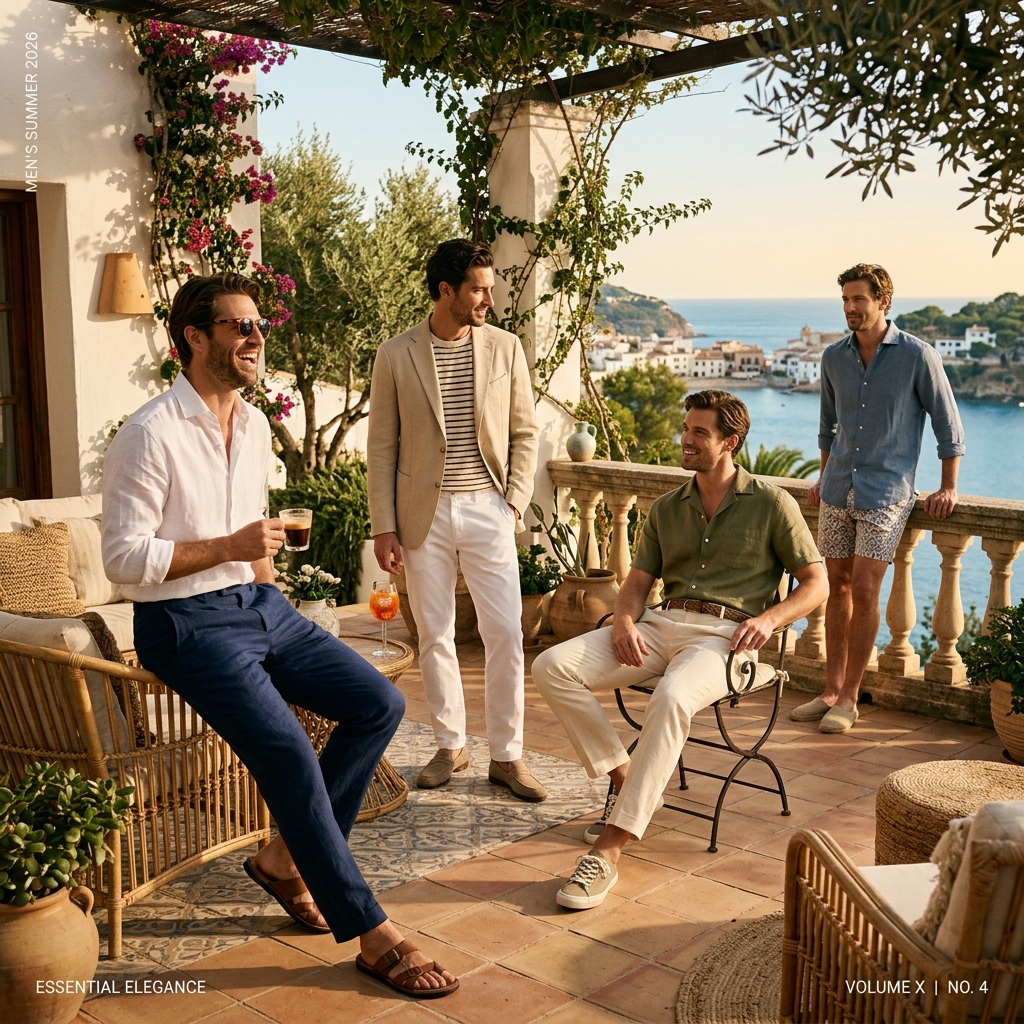
30 summer outfit ideas for men: casual classy style that actually works

Summer dressing for men sits in an uncomfortable middle ground. Too casual and you look like you're headed to a beach volleyball tournament. Too formal and you're overdressed for a 92-degree day. The sweet spot—what I call "casual classy"—requires understanding fabric behavior, color theory, and honest self-assessment about your lifestyle.

I've spent the last decade watching men fumble this transition. They buy linen shirts and wonder why they look rumpled after thirty minutes. They pair shorts with dress shoes and create visual discord. They ignore the basic mechanics of how fabric breathes, how proportions work in heat, and why certain combinations feel effortless while others feel forced.

This isn't about following trends. It's about building a functional summer wardrobe that doesn't require constant mental calculation.

understanding casual classy in summer heat

Casual classy isn't a style—it's a constraint. You're working within real limitations: sweat, humidity, the need to move without overheating, and the social expectation that you look intentional rather than like you grabbed whatever was clean.

The aesthetic emerged in the 1950s when men's magazines started photographing models in relaxed settings. Before that, summer meant either full linen suits (which required constant pressing) or you simply dressed down. The modern version combines elements of:

  • Italian summer dressing: Lightweight fabrics, earth tones, minimal layering, comfort-first mentality
  • American prep tradition: Clean lines, structured silhouettes, quality basics
  • Contemporary minimalism: Fewer pieces, higher quality, intentional color palettes

The difference between looking "casual classy" and just "casual" comes down to three factors: fabric weight and texture, fit precision, and color intentionality.

fabric selection: the foundation of summer dressing

This is where most men fail immediately. They see "summer" and buy the thinnest fabric available, then complain it wrinkles or clings to their body.

Linen gets romanticized beyond reality. True linen (100% or close to it) wrinkles aggressively. If you're wearing linen for casual classy, you're accepting visible wrinkles as part of the aesthetic. This works if you're intentional about it—a wrinkled linen shirt with tailored shorts reads as "I'm comfortable with myself." Accidental wrinkles read as "I didn't try." The difference is pressing the shirt initially and then accepting the creases that form during wear.

Linen blends (linen-cotton mixes at 55/45 or 60/40 ratios) offer a practical middle ground. They breathe almost as well as pure linen but hold their shape better and wrinkle less aggressively. Brands like Suitsupply and Proper Cloth offer these in structured cuts that don't require constant adjustment.

Cotton-silk blends work better than pure silk for summer. Silk alone feels slippery and looks too formal in casual contexts. A 70/30 cotton-silk blend gives you the drape and subtle sheen of silk with the stability and washability of cotton. These typically cost $80-150 for a quality shirt and last 5+ years with proper care.

Cotton poplin remains underrated. It's crisp, wrinkle-resistant, and photographs well. A poplin shirt in white, light blue, or neutral earth tones works across dozens of outfit combinations. The weight feels substantial without being heavy—typically 140-160 grams per square meter, compared to 200+ for heavier dress shirts.

Linen-cotton-viscose blends (sometimes labeled "summer weight") offer the best practical balance. Viscose adds drape and reduces wrinkling while maintaining breathability. These are common in contemporary menswear and typically cost $60-120.

Avoid pure viscose and pure rayon for casual classy. They're too fluid and read as feminine or costume-like in most contexts. They also wrinkle unpredictably and don't hold structured silhouettes well.
PROMPT: A close-up detail shot of fabric swatches laid flat on a natural wood surface in bright morning light. Show four different summer fabrics side by side: pure linen with visible texture, a linen-cotton blend, cotton poplin, and a linen-cotton-viscose blend. Each swatch should be approximately 4x6 inches. Capture the weave patterns and light reflection differences between fabrics. Shot with shallow depth of field, focusing on the linen first, with others slightly soft. Natural window light only, no flash. Aspect ratio 1:1 (square).


<p>“></p></p>

<h2>the 30 outfit formulas (not just ideas)</h2>

<p>Rather than listing thirty disconnected outfits, I'm giving you formulas. These work because they follow consistent logic about proportion, color, and context.</p>

<h3>lightweight shirts as anchors</h3>

<p><strong>1-5. The neutral poplin rotation</strong>: White poplin shirt + tailored shorts (navy, khaki, stone) + leather slides or minimal sneakers. This is your baseline. It works everywhere except formal events. Wear it to casual dinners, weekend errands, coffee meetings.</p>


<p><strong>6-10. Linen-blend camp collar shirts</strong>: These have a Cuban-style open collar and work untucked. Pair with tailored shorts in complementary colors. Wear with canvas sneakers or leather sandals. The camp collar reads as intentional—you're not pretending this is a dress shirt.</p>


<p><strong>11-15. Cotton-silk blend in earth tones</strong>: Camel, warm gray, soft olive, rust, or terracotta. Tuck these in (front tuck or full tuck depending on length and fit). Pair with flat-front shorts in neutral colors. Add a linen overshirt in white or cream for layering when temperature drops.</p>

<h3>shorts that actually fit</h3>

<p>This requires honesty. Most men wear shorts too long. The inseam should hit roughly at the top of your kneecap or slightly above. For casual classy, this means 7-9 inch inseams for most men (not the 11-13 inch baggy shorts sold at mall retailers).</p>


<p><strong>16-20. Tailored shorts in neutral tones</strong>: Navy, khaki, stone, olive, and charcoal. These should have a clean front (no pleats) and a slight taper through the leg. Brands like Bonobos, Banana Republic's better lines, and Suitsupply make these in proper fabrics (cotton-linen blends, lightweight cotton twill). Cost: $60-120. These last 3+ years.</p>


<p><strong>21-25. Patterned shorts for variation</strong>: Small-scale prints work better than loud patterns. Consider subtle checks, fine stripes, or micro-patterns. Pair these with solid, neutral shirts. A light blue shirt with navy micro-check shorts reads as intentional coordination.</p>


<p><strong>26-30. Chino shorts in unexpected colors</strong>: Beyond the standard palette, consider soft gray, warm taupe, or muted terracotta. These work with white, cream, or light blue shirts. The unexpected color combination signals you've thought about your outfit.</p>

<h2>layering without overheating</h2>

<p>Summer layering requires lightweight pieces that add visual interest without trapping heat.</p>


<p><strong>Linen overshirts</strong>: These are unstructured button-ups in linen or linen blends, worn open over a t-shirt or simple shirt. They add dimension and provide sun protection. Keep these in white, cream, or natural linen color.</p>


<p><strong>Unstructured blazers in linen</strong>: These are rare but worth seeking out. A natural linen blazer from brands like Smalto or bespoke makers works for elevated casual settings. It's not a dress blazer—it's softer, less structured, and designed for heat. These cost $300-600 but work for years.</p>


<p><strong>Lightweight cardigans</strong>: Not the chunky knit kind. Look for cotton or cotton-silk cardigans in neutral colors. These work for evening when temperature drops and add a layer of sophistication.</p>

<h2>color strategy for summer</h2>

<p>Summer allows more color freedom than other seasons, but casual classy still requires intentionality.</p>


<p><strong>The neutral base approach</strong>: Build outfits around white, cream, light gray, navy, khaki, or stone. These are your foundation. Add one accent color through either the shirt or shorts, never both in competing colors.</p>


<p><strong>Earth tone palette</strong>: Warm colors work better in summer heat psychologically and photographically. Camel, rust, olive, warm gray, and terracotta create cohesive outfits. These colors photograph well in natural light and feel intentional rather than random.</p>


<p><strong>Avoid neon and high-saturation colors</strong>: They read as casual-only, not casual-classy. A bright orange shirt signals "I'm at the beach," not "I'm put-together."</p>


<p><strong>White and cream as visual anchors</strong>: A white shirt or cream shorts create visual breathing room. They make other colors appear more intentional by contrast.</p>


<p><img decoding=30 summer outfit ideas for men: casual classy style that actually works

30 summer outfit ideas for men: casual classy style that actually works