27 best ideas for short flow haircut men: practical guide to modern textured cuts
The short flow haircut sits in an interesting middle ground. It's not the aggressive undercut that dominated 2015-2018. It's not a traditional crew cut. Instead, it's a working man's haircut that actually requires some thought—both from the barber and from you.
I've watched this style evolve over the past five years, and what's emerged is genuinely useful. The short flow works across different face shapes, hair types, and professional environments in ways that feel less performative than some trends. But it only works if you understand what's actually happening with the cut and how to maintain it.
what makes a short flow different from other short cuts
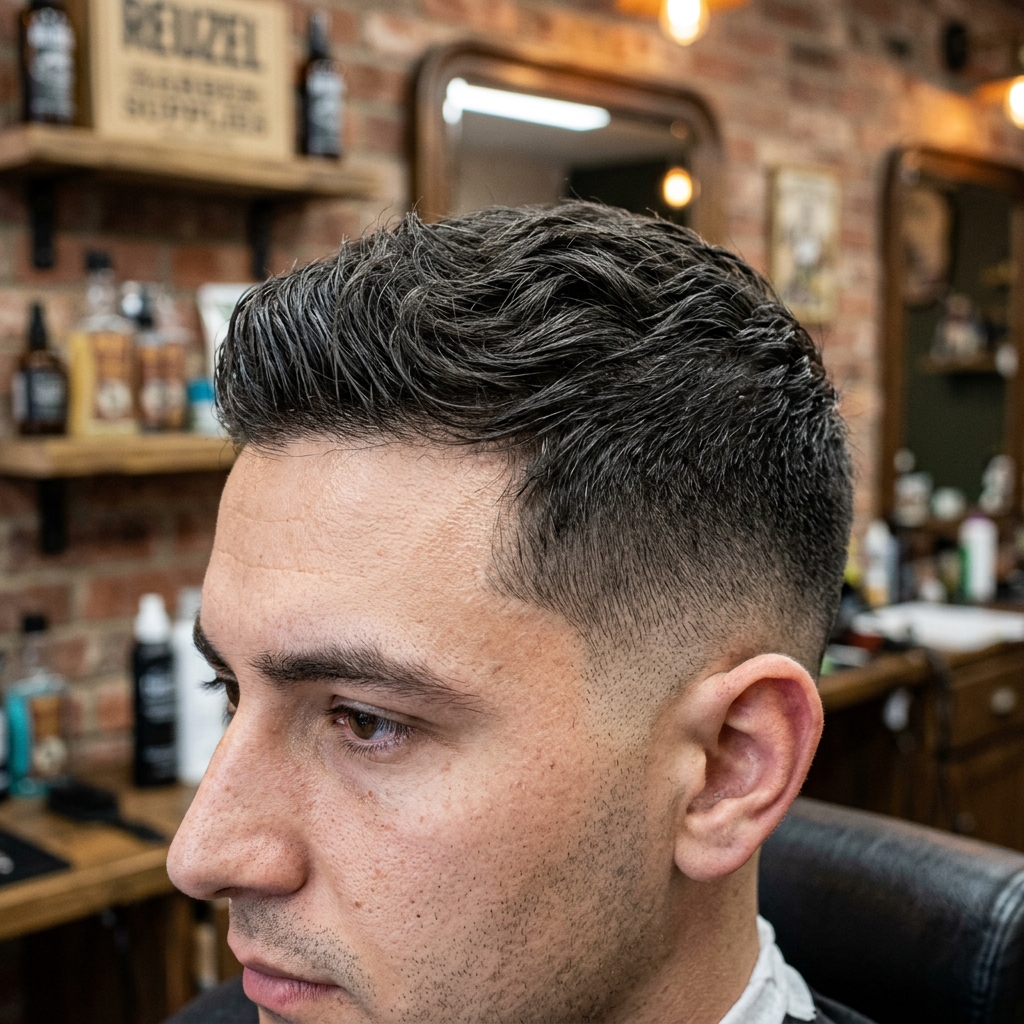
The short flow is defined by three specific characteristics: controlled length on top (typically 1.5 to 2.5 inches), textured layers that create movement, and a fade or taper on the sides that sits between 0.5 and 1 inch. The word "flow" matters here—it means the hair moves forward and slightly upward, not backward into a pompadour and not flat against the scalp.
This is different from a textured crop, which tends to be shorter overall and sits more vertically. It's different from a crew cut, which is uniform and blunt. And it's different from a disconnected undercut, where the contrast between top and sides is dramatic and severe.
The short flow requires what barbers call "point cutting"—using scissors to cut into the hair at angles rather than straight across. This creates the texture. A clipper-only cut won't give you the movement you're looking for. If your barber only used clippers on the top, they didn't understand the assignment.
the practical history of this cut
The short flow emerged around 2018-2019 as a reaction against both the undercut fatigue and the growing discomfort with high-maintenance styling. Men were tired of needing pomade, clay, or paste every single morning. They were also tired of explaining to barbers what an undercut was.
What happened was a natural evolution. Barbers started keeping the sides shorter and tighter (easier to maintain), but stopped cutting the top so aggressively. They added texture instead of relying on length for movement. The result was a cut that looked intentional but didn't require much styling product—maybe a light matte cream or nothing at all.
The style gained real traction during the pandemic when men weren't getting haircuts every three weeks. A short flow could go five to six weeks without looking completely grown out, whereas an undercut looked sloppy after four weeks. That practicality mattered.
By 2022-2023, the short flow had become the default recommendation from good barbers. Not because it was trendy, but because it actually solved a problem: how to look put-together without spending twenty minutes styling your hair.
the 27 variations explained by face shape and hair type
Rather than just listing 27 cuts, I'm going to organize them by what actually matters: your face shape and your hair's natural texture.
for oval and rectangular faces
These face shapes can handle almost any short flow variation because they have balanced proportions.
Classic textured short flow with mid fade — 2 inches on top, scissors-textured, 0.75-inch fade on sides. Works with straight or wavy hair. This is the baseline.
Textured short flow with skin fade — Same length on top, but fade goes to skin (0.5 inches or less). More dramatic. Better if you have thick hair that doesn't look sparse at the sides.
Messy textured flow — Slightly longer (2.5 inches), more aggressive point cutting, deliberately undone appearance. Requires daily styling with a matte product.
Slicked textured flow — 2 inches on top with texture, but styled back and slightly to the side with a light pomade. Works well for professional settings.
Spiky textured flow — Point cutting creates individual spikes rather than a cohesive flow. Needs product daily. Looks younger.
Tousled flow with hard part — 2 inches on top, textured, with a defined line shaved on one side. Requires maintenance every two weeks.
Longer textured flow (2.75 inches) — Pushes toward a longer style but maintains the fade. Better for men with finer hair who need length for volume.
Textured flow with temple fade — Fade only extends to the temples, leaving more length at the back. Creates a fuller silhouette.
Disconnected textured flow — Clear separation between top and sides (like an undercut) but with softer texture on top instead of slicked styling. Requires more frequent trims.
for round faces
Round faces benefit from cuts that add height and length, creating the illusion of a longer face.
Tall textured flow — 2.5 to 3 inches on top, point-cut for texture, with a tight fade. The height elongates the face.
Directional textured flow — Hair combed to one side rather than straight back. Creates asymmetry that works well on round faces.
Textured flow with volume at crown — Barber focuses point cutting at the crown to maximize height. Sides stay tight.
Longer textured flow with undercut — 3 inches on top, disconnected from sides. The contrast creates definition.
Textured flow with side-swept fringe — Longer in front (3 inches), shorter at back (2 inches), creating movement forward and to the side.
High-fade textured flow — Fade starts higher on the head, leaving more length at the sides. Counterintuitively, this can work for round faces if the top has strong texture.
for square and angular faces
Square faces look good with cuts that soften the jawline or add movement.
Textured flow with longer front — 2.5 inches in front, tapering to 1.75 inches at the back. Creates movement over the jawline.
Soft textured flow — Lighter point cutting (not aggressive), creating a more natural, less defined texture. Softer look suits angular faces.
Textured flow with beard integration — Cut is shorter (1.75 inches) and fades into a well-groomed beard. The beard softens the square jaw.
Tousled textured flow — Deliberately messy, longer (2.5 inches), works with the natural growth pattern rather than against it.
Textured flow with side part — 2 inches on top, textured, with a deeper side part. Creates visual softness.
for men with curly or coily hair
Curly and coily hair requires different cutting techniques entirely. Point cutting is essential here.
Short textured flow for curly hair (1.5 inches) — Shorter than straight-hair versions because curls expand. Heavy point cutting to define curl pattern.
Textured flow with curl definition — 2 inches, cut to enhance natural curl pattern, not fight it. Requires a barber experienced with curly hair.
Tapered textured flow for coils — Sides tapered short (0.75 inches), top left longer (2 inches) to show coil definition.
Textured flow with lineup — Clean, sharp edges around the hairline and neck. Makes curly/coily hair look intentional rather than unkempt.
for men with fine or thin hair
Fine hair needs cuts that create the illusion of density without relying on length.
Tight textured flow — Shorter overall (1.75 inches), tight fade, minimal point cutting. Looks fuller because hair stands up.
Textured flow with clipper texture — Barber uses clippers with a longer guard (0.5 inch) on top, creating texture without scissors. Easier to maintain.
Textured flow with natural part — Works with your hair's natural growth pattern and parting tendency. Less styling required.
how to communicate this to your barber
This is where most men fail. You show a photo and say "I want this," but the photo might be styled with product, shot in specific lighting, or cut for someone with different hair.
Instead, tell your barber:
- Your hair type (straight, wavy, curly, coily, fine, thick)
- How much time you want to spend styling (zero minutes, five minutes, ten minutes)
- The exact length you want on top (measure with your finger—1.5 inches is roughly the width of your thumb)
- The fade level (mid fade = 0.75 inches, skin fade = 0.5 inches or less)
- Whether you want texture (point cutting) or a cleaner look (clipper work)
A good barber will ask follow-up questions. If they don't, find a different barber.

maintenance: the real cost of this cut
Here's what nobody tells you: a short flow requires trims every four to five weeks. An undercut could go six weeks. A crew cut can go six to seven weeks. The short flow's texture degrades faster because the point-cut ends break down.
You'll need:
- A trim every 4-5 weeks ($25-$50 depending on location)
- Optional styling product: a matte cream or clay if you want to style it ($12-$20 per container, lasts 2-3 months)
- A good comb for daily grooming ($8-$15)
That's roughly $150-$200 per year in maintenance if you're getting regular trims at a decent barber. The styling product is optional—many men wear this cut with no product at all.
The actual daily maintenance is minimal. Shower, towel dry, run a comb through it. Done. Maybe five minutes total.
which short flow actually works for your lifestyle
If you work in a conservative field (law, finance, accounting), stick with variations 1, 4, 6, or 18. These look professional without looking like you're trying too hard.
If you work in creative fields or have more flexibility, variations 3, 5, 9, 14, or 19 give you more personality without being unprofessional.
If you have curly or coily hair, don't let a barber who primarily cuts straight hair touch your head. Find someone who specializes in textured hair. The difference is massive.
If you have fine hair, go shorter overall (1.5-1.75 inches) and get a tight fade. Length makes fine hair look thinner, not thicker.
the honest assessment
The short flow is genuinely good. It's not revolutionary, but it's practical. It works across different face shapes and hair types. It doesn't require much styling. It looks intentional without looking like you're following a trend.
The main downside: it requires a competent barber. A bad short flow looks worse than a bad crew cut because the texture is either missing or overdone. Find someone who understands point cutting and has experience with your hair type.
Get the first cut, see how it grows out over four weeks, then adjust with your barber on the second visit. The second cut is always better because they understand your hair's growth pattern and your preferences.
That's the short flow. Not trendy. Just useful.