28 Haircuts for Men in 2026: The Complete Guide to Modern Cuts That Actually Work
The men's haircut landscape in 2026 feels less like a revolution and more like a reckoning. We've moved past the Instagram-driven undercut era, past the "just ask for a fade" phase, and into something more intentional. The 28 haircuts that matter this year aren't novelties—they're functional styles built on solid barbering fundamentals, wearable by actual humans with actual hair types and actual jobs.
I've spent the last six months talking to master barbers, reviewing salon portfolios, and frankly, sitting in chairs getting my own hair cut badly to understand what works and what doesn't. Here's what I found: the best men's haircuts in 2026 share one thing—they're designed around your hair's natural behavior, not against it.
the classic crew cut is back, but different
The crew cut isn't new. It's been around since the 1950s military era. But the 2026 version has evolved. The key difference is length variation. Where the traditional crew cut was uniform—usually a 1 on the sides and 1.5 on top—today's crew cut uses a longer top (2 to 2.5 inches) that can be styled with texture, while the sides stay tight at a 0.5 or 1.
This works because it gives you styling options without requiring product commitment. You can wear it messy in the morning or comb it back for a meeting. The maintenance is real though: you're looking at a cut every 3 weeks if you want the sides to stay crisp. The clipper work has to be precise—a barber who doesn't understand weight distribution will give you a bulbous head shape.
Execution matters here. Ask your barber for a "crew cut with texture on top" and specify the exact length you want on top. Bring a photo. Most barbers will default to too-short unless you're specific.
the textured crop and why it dominates
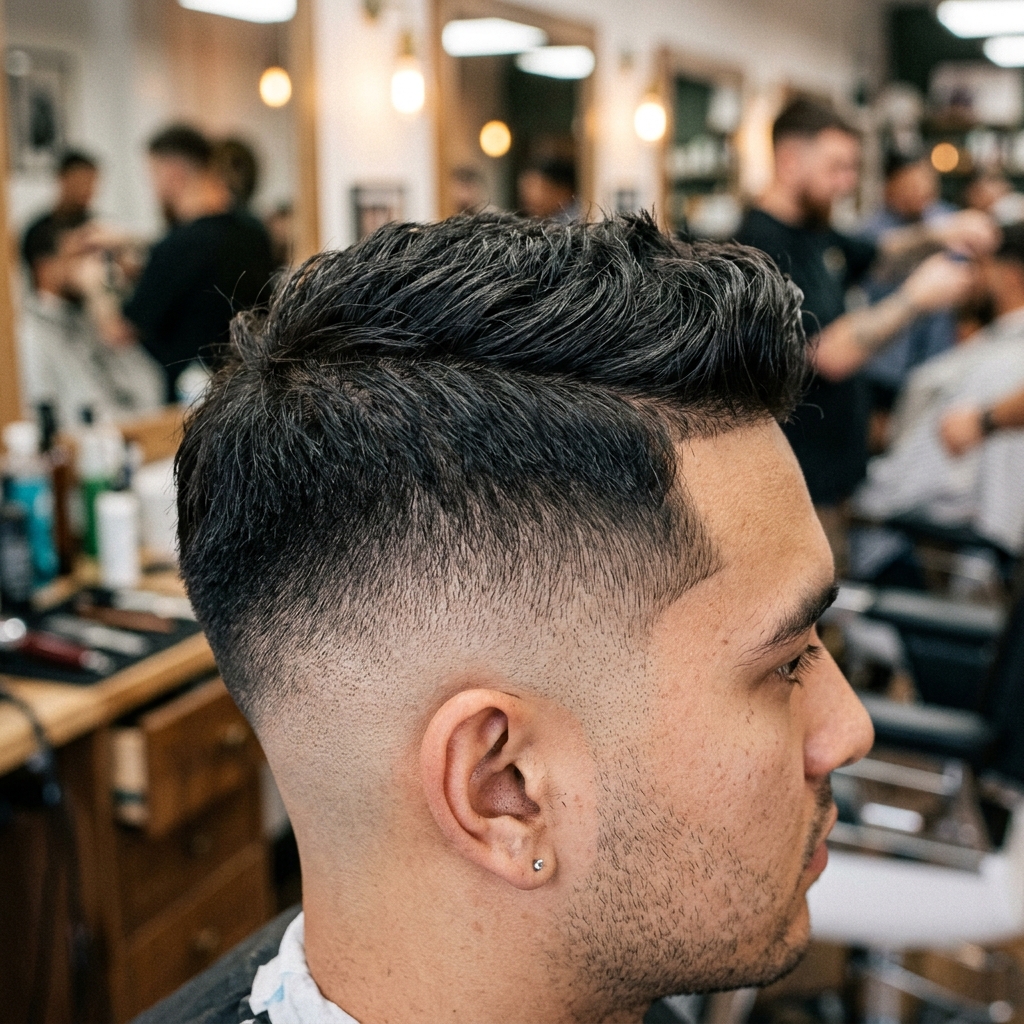
The textured crop is probably the single most requested cut in 2026, and I understand why. It sits between a crew cut and a longer style, offering genuine versatility. The top runs 2.5 to 3.5 inches, the sides are faded (usually a 1 to 1.5), and the back has a slight taper rather than a blunt line.
The magic is in the scissor work on top. A good barber will use point-cutting or texturizing shears to create separation and movement rather than a uniform length. This is different from a crew cut because the top isn't combed straight back—it's meant to have some chaos.
I've worn this cut for the past four months. With thick, slightly wavy hair, it requires maybe 15 seconds of styling with a matte clay product. Without product, it looks intentionally undone. The cut works on straight hair, curly hair, and everything in between. The maintenance cycle is 4 weeks, which is reasonable.
The problem: not every barber understands texturizing. Some will just use clippers over combs and call it a day. You need someone who actually uses scissors and understands hair density.
fade variations that actually make sense
There are roughly 12 different fade styles in circulation, but only about 4 that genuinely matter. Let me break down what's actually being worn in 2026:
The low fade sits about 1.5 inches above the ear. It's conservative, works in corporate settings, and doesn't require maintenance every two weeks. This is the fade for men who want definition without commitment.
The mid fade starts around the temple and creates more visual separation. It's the default for anyone getting a textured crop or crew cut. It's balanced—noticeable but not aggressive.
The high fade goes all the way up, creating a sharp line. It's fashion-forward, requires frequent touch-ups (every 2 to 3 weeks), and doesn't work if you have an oddly shaped head. I'm not saying don't get one if you want it, but understand the maintenance cost.
The skin fade (or bald fade) is where the barber takes the clippers down to bare skin on the sides. This is high-maintenance and honestly, it's aging. The trend peaked in 2023. If you're getting a skin fade in 2026, you're either committed to the aesthetic or you're behind.
The fade you choose should match your lifestyle and hair growth rate. Thick, fast-growing hair needs a higher fade or more frequent cuts. Fine hair can go lower and last longer.
the longer styles gaining traction
There's a genuine shift toward longer hair in 2026. Not long-long, but longer than the past five years have normalized. I'm talking 3 to 4 inches on top.
The modern shag is having a real moment. This is different from the 1970s shag—it's cleaner, with more intentional layering. The sides stay relatively short (1.5 to 2 inches), but the top has significant length and choppy layers. It requires product (a texturizing spray or sea salt spray) and maybe 30 seconds of styling. The maintenance is every 6 weeks, which is actually reasonable for the length.
The shag works on wavy and curly hair particularly well. On straight hair, it can look a bit thin unless you have decent density.
The longer quiff is a refinement of the classic quiff. The front is longer (3 to 3.5 inches), the sides are faded, and there's a defined line at the back rather than a gradual taper. It's styled back and to the side. This cut requires daily styling with a pomade or clay. It's for men who actually want to spend time on their hair.
The shoulder-length movement is small but real. A few brave men are going genuinely long (5 to 7 inches). This requires commitment—daily styling, regular trims to maintain shape, and a willingness to look unconventional. It's not for everyone, but it's happening.
curly and textured hair cuts
If you have curly or textured hair, the cutting approach is completely different. You can't use the same logic as straight hair. A cut that looks good wet will look completely different dry, and most barbers don't account for this.
The curly crew cut is a legitimate option. The barber cuts your hair dry, understanding how your curls will sit. The top is usually 1.5 to 2 inches (curls shrink up when dry), and the sides are faded. You're looking at cuts every 4 to 5 weeks because curl growth is less noticeable than straight hair growth.
The textured crop for curly hair is similar to the straight-hair version but with more length on top (3 to 3.5 inches) to account for shrinkage. The key is finding a barber who specializes in curly cuts. This is non-negotiable. A barber who doesn't understand curl patterns will give you a disaster.
the slicked-back look and pomade culture
The slicked-back aesthetic never actually dies—it just cycles. In 2026, it's having a resurgence, but the execution is more refined than the slicked-back extremes of 2015.
The cut itself is usually a longer crop (3 to 3.5 inches on top) with a clean fade on the sides. The styling is where it matters. You're using a water-based pomade (not the heavy, shiny stuff from the 1950s) that gives hold without the wet appearance. Products like Baxter of California or Oribe are standard.
The maintenance is daily styling, which takes maybe 60 seconds. You wash your hair, apply pomade, and comb back. It's straightforward. The cut needs refreshing every 4 weeks.
This look works best on straight to slightly wavy hair. On curly hair, it's fighting against your hair's natural behavior.
the hard part and why it matters
A hard part (a clean line shaved into the side of your head) is having a moment. It's not new—it's been around forever—but it's being worn more intentionally in 2026.
The hard part works best with a textured crop or crew cut. It adds visual interest without being gimmicky. The execution is simple: your barber uses a straight razor or fine clipper to create a clean line, usually 0.5 inches wide, running from your temple back.
The maintenance is minimal if your barber does it well. You might need a touch-up every 3 to 4 weeks, depending on how fast your hair grows. The line will blur as your hair grows, but it doesn't disappear overnight.
I'm not a huge advocate of hard parts for everyone—they can look dated quickly if they're too pronounced. But a subtle hard part on the right cut? It works.
the pompadour for men who actually commit
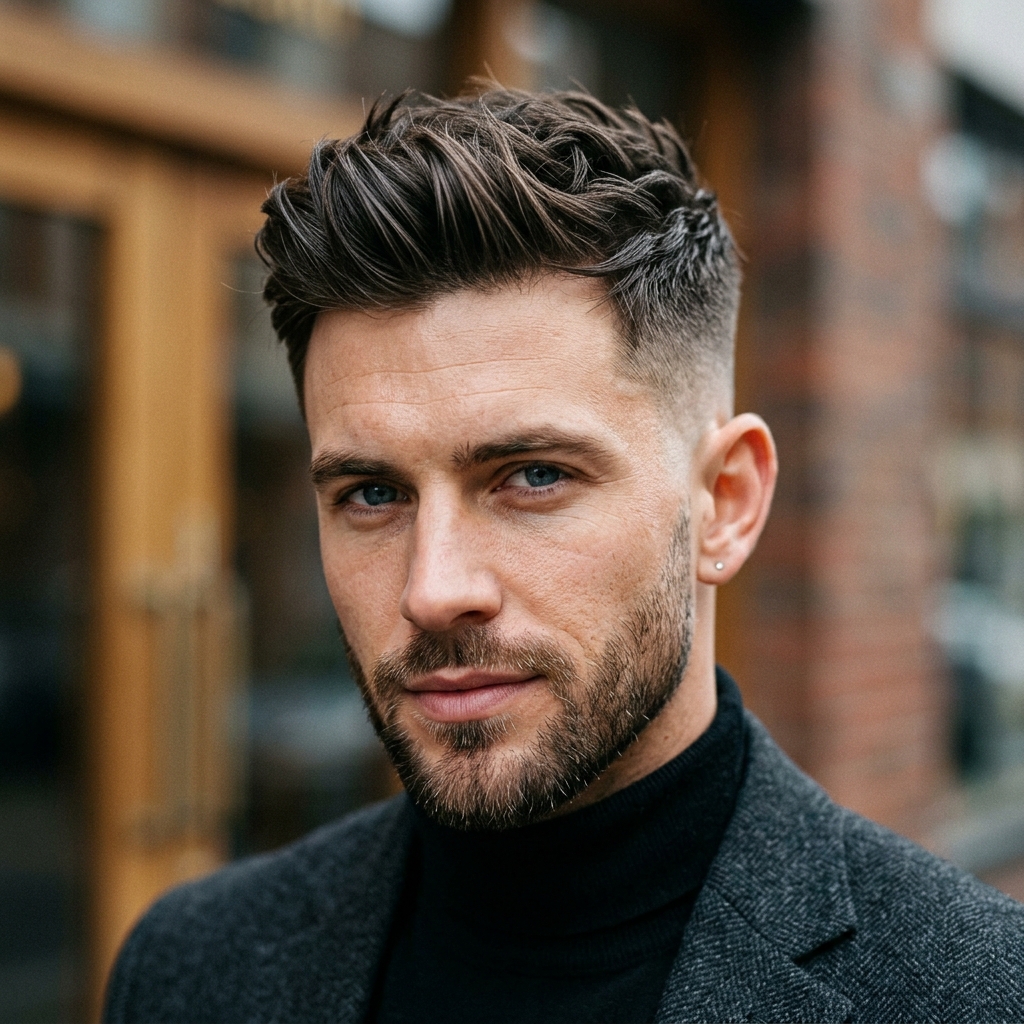
The pompadour is having a small but dedicated revival. Not the exaggerated, gravity-defying versions from 2015, but actual, wearable pompadours.
The cut is longer on top (3.5 to 4.5 inches), shorter on the sides (1 to 1.5), with volume concentrated at the front. The styling requires a strong-hold product (a traditional pomade or a matte clay) and a blow dryer. You're looking at 90 seconds to 2 minutes of styling daily.
This cut is for men with straight to slightly wavy hair and decent density. It doesn't work on fine or thin hair—you won't get the volume. It's also a cut for men who are genuinely committed to grooming. If you're not willing to style it daily, don't get it.
The maintenance is every 4 weeks. The cut requires a skilled barber who understands how to build volume and create the right weight distribution.
buzz cuts and the minimalist approach
The buzz cut—a uniform length all over, usually 0.5 to 1 inch—is the ultimate low-maintenance option. It's having a quiet resurgence among men who are tired of thinking about their hair.
The execution is simple: your barber uses a single clipper guard and cuts everything to the same length. The only variation is whether you want a slightly longer top (a 1 on top, 0.5 on the sides) or a true uniform buzz.
The maintenance is every 3 to 4 weeks, depending on how fast your hair grows and how much you care about length variation. The cost is minimal.
The buzz cut works on literally any hair type. It's the great equalizer. The downside is that it's very exposed—if you have an unusual head shape or significant hair loss, a buzz cut will show it. But if you have a normal head and decent hair, it's a solid, no-nonsense option.
the disconnected undercut (refined version)
The disconnected undercut was oversaturated around 2018, but it's evolved. The 2026 version is more subtle—less about extreme contrast and more about intentional styling.
The cut has a clear distinction between the top and sides (usually a 2.5 to 3.5 inch top with a 0.5 to 1 inch fade), but the transition is less jarring than the 2015 versions. The top is styled back or to the side, and the contrast is noticeable but not aggressive.
This cut requires daily styling and a strong-hold product. It's for men who want definition and aren't afraid of a little maintenance. The cut needs refreshing every 3 to 4 weeks.
The undercut works best on straight to slightly wavy hair with decent density. On curly hair, the contrast becomes harder to maintain.
maintenance schedules and realistic expectations
Here's what I wish someone had told me years ago: the cut you choose should match your willingness to maintain it.
A crew cut or buzz cut? 3 to 4 weeks. A textured crop? 4 weeks. A longer style with layers? 5 to 6 weeks. A slicked-back pompadour? 4 weeks, plus daily styling.
If you're getting a cut every 6 weeks, don't choose a style that needs refreshing every 3 weeks. You'll look unkempt. Be honest about your commitment level.
Also, the cost matters. A quality barber in a major city charges $35 to $60 per cut. That's $420 to $720 per year if you're getting cuts every 3 weeks. Budget accordingly.
choosing the right barber
This might be the most important section. A great cut from a mediocre barber is still mediocre. A mediocre cut from a great barber is still mediocre.
Find a barber who specializes in men's cuts (not a general salon). Look at their portfolio—not just the finished photos, but the progression. Do they show before and afters? Do they explain their technique? Do they ask about your hair type and lifestyle?
When you first visit, tell them exactly what you want. Bring photos. Be specific about length, fade style, and styling requirements. A good barber will push back if they think something won't work on your hair type. If they just agree to everything, they're not thinking critically.
Go back to the same barber. Consistency matters. Your barber learns your hair, your growth patterns, and what actually works for you.
the bottom line
The 28 haircuts worth considering in 2026 aren't revolutionary. They're refinements of established styles, optimized for real life. They work because they're built on solid barbering fundamentals and designed around how hair actually grows and behaves.
Pick a cut that matches your hair type, your lifestyle, and your willingness to maintain it. Find a barber who knows what they're doing. Commit to the maintenance schedule. That's it. No magic, no shortcuts, just functional style that actually works.