40 handsome men's hairstyles fade: the cuts that still work in 2026
The fade hasn't peaked. It's been at the center of men's haircutting for over a decade and remains there because it solves real problems: it creates clean visual lines, it transitions naturally from short to longer hair, and it provides structure without restricting what you do on top.
The better question isn't whether fades work—they do—it's which fade variation works for your hair type, face shape, and lifestyle. The number of permutations has expanded significantly over the past several years, and navigating them well requires understanding what's actually different between them rather than just picking whichever image looks best at first glance.
what a fade actually is
A fade is a gradient of hair length, where the hair transitions smoothly from very short or bare skin at the sides and back to longer hair higher on the head. The starting point of that gradient—where it begins and how aggressively it transitions—is what differentiates one fade from another.
The three key variables: height (low, mid, or high), tightness (how abruptly the transition happens), and finish at the base (skin or very short—"bald" fade vs. a simple close taper).
the main fade types explained
low fade
The gradient begins just above the natural hairline at the ear and the nape of the neck. This is the most conservative fade variant—it maintains a fuller look across the sides while still providing a clean, tapered edge.
Best for: professional environments, men who want a more traditional barbershop look, men with round faces (less visual narrowing effect than a high fade).
Grow-out: the most forgiving. A low fade still looks reasonably clean at four weeks.
mid fade
Begins roughly halfway up the side of the head, around the temple area. The most popular current fade height. It creates enough contrast to look modern without the sharp, high-contrast aesthetic of a skin fade.
Best for: most face shapes and most contexts. The balanced choice when you're unsure.
high fade
The gradient begins above the temple, often at the top of the ears or higher. This creates a substantial visual contrast between the sides and the top, giving a strong, strong-lined appearance.
Best for: strong jawlines and defined bone structure. Emphasizes facial features aggressively.
skin fade (bald fade)
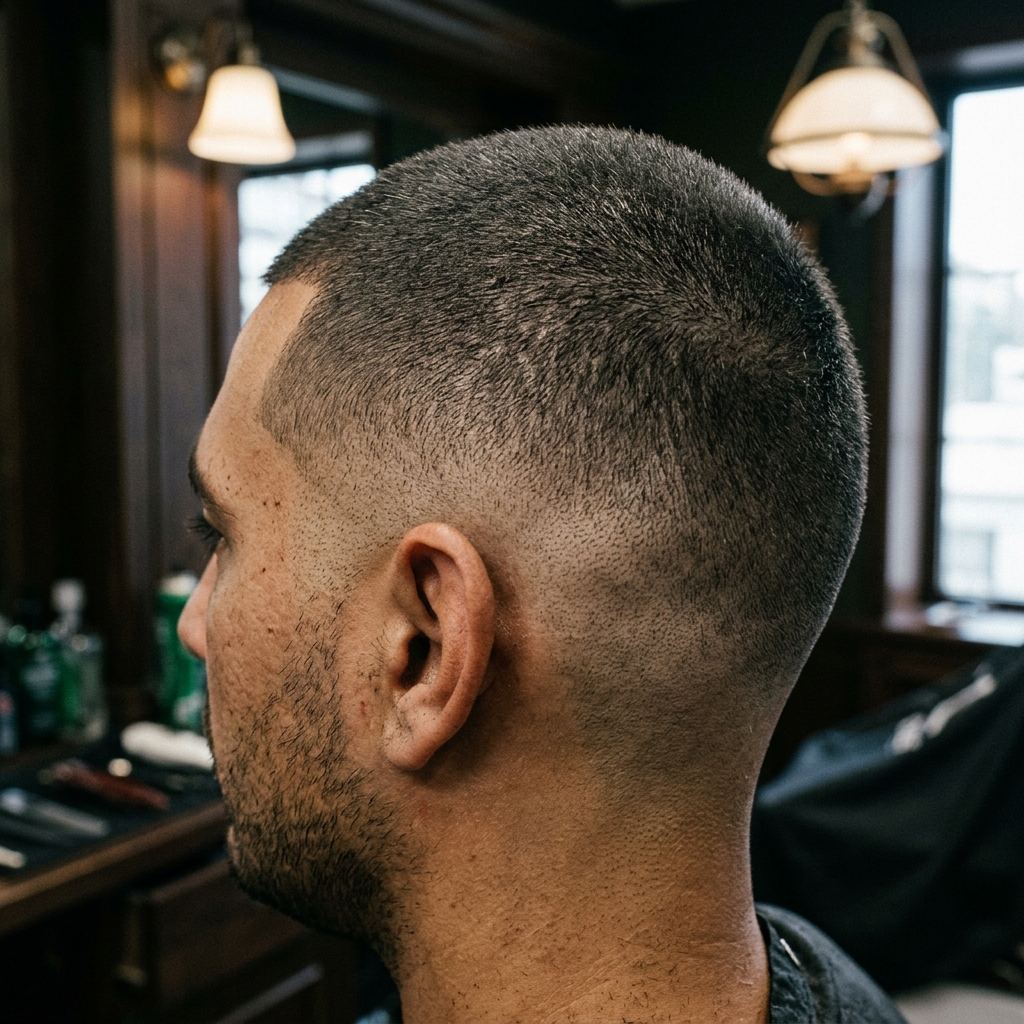
The hair disappears entirely at the base of the fade, blending to bare skin. This is the highest-contrast fade variation and requires the most frequent maintenance—typically every 2–3 weeks before growth becomes visible against skin.
The aesthetic reads as sharp and contemporary. In Black barbering culture specifically, the skin fade with a defined lineup at the temples is a cornerstone of professional presentation.
drop fade
A variation where the fade "drops" down behind the ear into a curve, following the natural shape of the head rather than running in a straight line around the sides. This creates a more curved silhouette and often looks more natural and dynamic than a standard straight fade.
Works particularly well with the curly or textured hair on top—the curved fade line complements natural hair movement.
burst fade
Radiates out from behind the ear in a circular pattern. Frequently used in combination with mohawks, textured tops, or cornrowed styles. This creates a distinctive "halo" effect. It's a statement fade rather than a subtle one.
temple fade (Brooklyn fade)
A shorter, more contained fade focused at the temples rather than across the full sides of the head. It's less aggressive than a full skin fade, creating clean lines at the front hairline while maintaining more volume through the sides.
Common in Latin barbering traditions as an alternative to full side fading.
fade combinations that work well in 2026
skin fade + textured crop
The textured French crop sits above a skin fade perfectly. The top section (1–2 inches) is cut with point-cutting shears to create natural movement, then styled with a small amount of matte clay. The skin fade provides the contrast and definition that makes the muted top section read as intentional.
mid fade + loose quiff
A mid-length quiff (2–3 inches on top, styled upward and slightly forward) over a mid fade is a combination that's been popular for several years without dating itself. The key is the product choice: use a light pomade or medium-hold clay rather than a heavy wax, which creates a stiff, outdated look.
drop fade + curly top
For men with natural curl, a drop fade that follows the curve of the head and allows curls to bloom on top creates one of the most visually interesting combinations in current barbering. The curls provide texture and volume; the curved fade gives clean structure below.
low fade + side part
The most professional combination on this list. A clean side part with 1.5–2 inches of length on top over a low taper fade reads as polished and deliberate. Appropriate in virtually any work environment, formal event, or semi-formal social context.
high skin fade + flat top (modern revival)
The flat top—a haircut where the top section is cut completely level to form a flat horizontal plane—is experiencing a revival in contemporary barbering. Paired with a tight skin fade at the sides, it creates a bold geometric silhouette that's a clear aesthetic statement.
Not for everyone. Requires commitment and frequent maintenance.
fade by hair texture
Straight hair: All fade variations work. The challenge is that fades on straight hair are more visually precise—any inconsistency in the barber's technique is immediately visible. Choose a barber with demonstrated precision.
Wavy hair: Mid and drop fades work particularly well. The natural wave on top creates movement that complements the structure of the fade below.
Tight curl or coily hair: The skin fade is the native environment of very tight, coily hair. The contrast between bare skin and coily hair is sharp and defined, and the fade lines are as clean as they can be. The lineup (a precise edge at the hairline) is a natural complement.
Loc styles: Fades work beneath starter locs or shorter locs. As locs grow longer, the fade at the base becomes less relevant—the volume comes from above rather than the contrast at the sides.
maintenance reality for fades
The higher and tighter the fade, the faster it grows out visibly. A realistic maintenance schedule:
- Skin fade: 2–3 weeks
- High fade: 3–4 weeks
- Mid fade: 4 weeks
- Low fade / low taper: 4–6 weeks
Factor this into your choice. If you're going to a barber once a month, a skin fade won't hold up, and you'll spend two of those four weeks with visible grow-out you didn't plan for.
what to ask your barber
Be specific about:
- The height of the fade (low, mid, high)
- Whether you want skin fade or a close taper that doesn't go to skin
- If you want a straight fade line or a drop fade
- Whether you want a nose lineup
A reference photo is always useful. Pull one up on your phone and show it. Barbers can replicate a specific result far more accurately than they can interpret a verbal description.
aftercare and home maintenance
Between visits, a few things help maintain the fade:
- Keep the hairline clean by shaving the neck and nape yourself with a trimmer
- Moisturize the scalp—faded scalp skin can dry and flake
- Use a softer product on the top to prevent heavy buildup
- Avoid heavy styling products that cause residue at the fade line
A small edge trimmer or foil shaver for home use is worth the investment if you have a skin or high fade—it lets you maintain the hairline between visits.
The fade isn't a trend you can outrun. It's a technical solution to a haircut problem—how do you transition from short sides to any top length cleanly and attractively? Until someone solves that problem differently, the fade stays relevant.
Pick your variation based on realistic maintenance capacity and honest assessment of what your face shape and hair type respond to. Execute it with a competent barber and maintain it on schedule. That's the entire formula.