40 men’s winter fashion styles: how to dress well when it’s actually cold
Winter is where men’s style either gets serious or completely falls apart. The cold introduces both opportunity and failure modes. More layers mean more decisions, but more decisions mean more chances to get it right or wrong.
To ensure your grooming is as sharp as your wardrobe, take a look at our guide on 40 short hairstyles for men.
The men who look genuinely good in winter understand that warmth is not the enemy of style—it’s neutral. Ugly winter dressing comes from buying whatever is warmest without thinking about whether it works together. Well-executed winter dressing comes from choosing pieces that solve the warmth problem while maintaining a coherent visual logic.
the outer layer is everything
In winter, the coat determines the outfit. Everything underneath is largely irrelevant from a visual standpoint once the coat is on—which means choosing the right coat is the most important winter fashion decision you’ll make.
the wool overcoat
The most versatile winter garment available. A single-breasted wool overcoat in charcoal, camel, or mid-gray works over a suit, over smart-casual, and over a hoodie-and-jeans combination. The quality of the wool—100% wool, at least 400g/m² for genuine insulation—determines both warmth and longevity.
Cut: Mid-length (ending just above or at the knee) is the most universally flattering and most formally appropriate. Shorter overcoats (field jacket length) work in casual contexts. Longer overcoats (ankle-length) are dramatic and work in specific contexts.
Color: Camel is the power color of winter menswear. Charcoal is the most flexible. Navy is versatile but more conservative. Avoid novelty colors in an investment overcoat—they date more quickly.
the structured puffer
The technical alternative to the wool overcoat. Down or synthetic insulation in a structured (not boxy) shell with a clean finish. The contemporary puffer doesn’t look like camping gear—it looks like outerwear.
What separates a great puffer from a bad one: The shell fabric (a tightly woven nylon or ripstop looks better than a shiny, plasticky finish), the construction (channel-quilted down puffers look cleaner than boxy division quilting), and the fit (it shouldn’t add significant width or bulk to the silhouette).
Colors: Muted tones perform best—black, navy, forest green, dark olive, camel. Bright puffers work only in very specific style contexts.
the wool blazer or suit jacket as outer layer
In moderate cold, a well-structured wool blazer worn as the outer layer over knitwear and a shirt is a genuinely warm combination that maintains a smart-casual or formal register. This doesn’t work in extreme cold—you’ll need an actual coat—but in temperatures above freezing, it’s an elegant option.
the waxed canvas jacket
The workwear or heritage choice. A Barbour-style waxed cotton jacket in olive, brown, or navy is genuinely weatherproof, ages beautifully, and provides moderate insulation. It sits between casual and smart-casual depending on what’s under it.
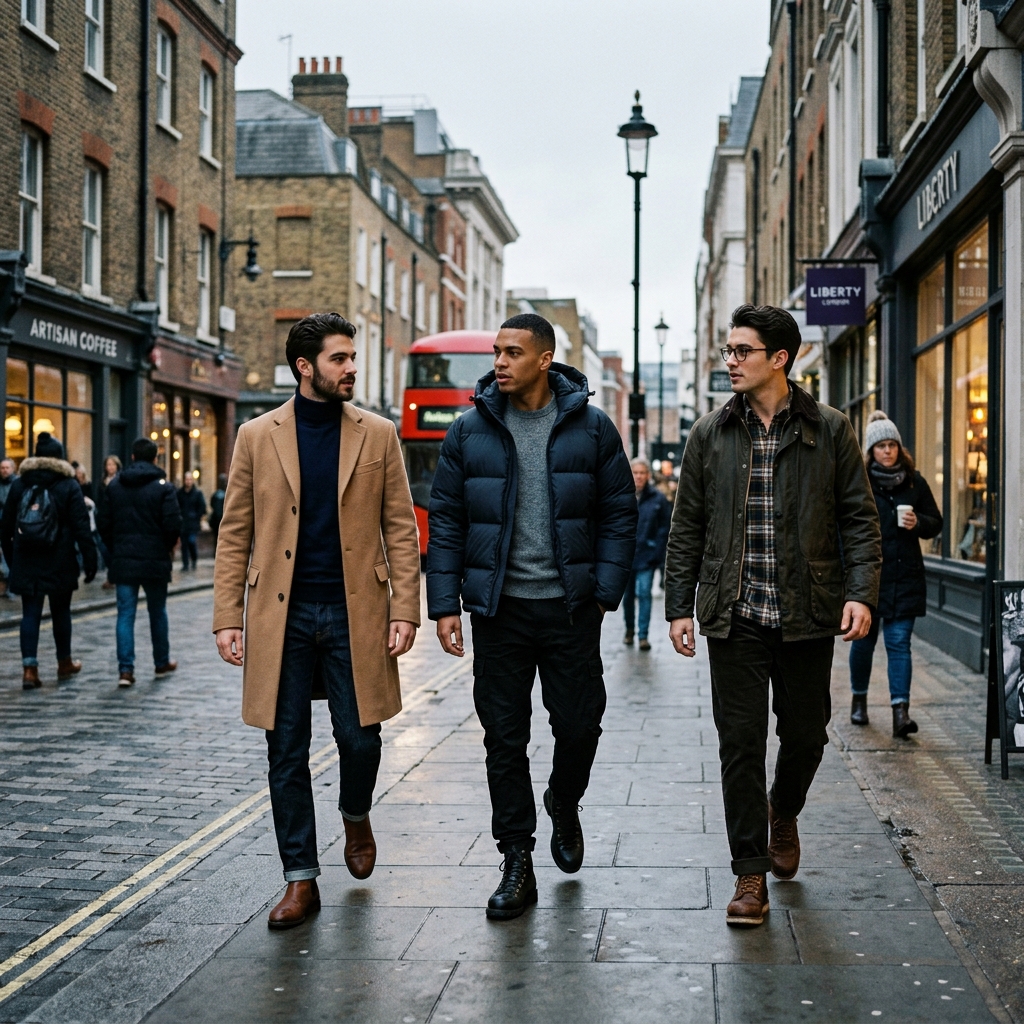
layering for warmth without looking like you can’t move
The functional layer system:
Base layer (next to skin): Merino wool or heavyweight cotton. Merino wool has the highest warmth-to-weight ratio of any natural fiber and doesn’t itch. A merino undershirt or thin turtleneck provides meaningful warmth without visible bulk.
Mid layer: A sweater or heavy knit. Crew neck or turtleneck in merino, lambswool, or cashmere. This is the visible layer when the outer layer comes off. Invest here—a well-made merino crew neck lasts decades.
Outer layer: The coat, jacket, or blazer as described above.
The mistake most men make: buying too many mid-layers and ignoring the quality of the outer layer. A cheap coat over good knitwear still looks like a cheap coat.
the specific outfit systems
smart-casual winter
- A well-fitted merino turtleneck in charcoal, camel, or dark navy
- Slim or straight-leg trousers in a wool or wool-blend fabric
- Chelsea boots in brown or black leather
- A camel or charcoal wool overcoat
- Optional: a slim leather belt
This combination works for dinner, professional meetings in creative industries, gallery openings, and most social events that aren’t strictly formal.
casual winter
- A heavyweight crewneck sweater (lambswool or cashmere blend) in a mid-tone—burgundy, forest green, camel
- Dark straight-leg jeans (no distressing)
- Clean white or off-white sneakers, or worn leather boots
- A structured puffer or shorter waxed canvas jacket
This is the weekend standard that, if done with quality pieces, looks genuinely intentional.
formal winter
- A charcoal or navy wool suit with a properly fitted cut
- A white or pale blue dress shirt
- A simple silk or silk-blend tie
- Oxford shoes in black or dark brown
- Over it: a formal overcoat in charcoal or navy
The only modification from any other season: the overcoat. Well-fitted winter suits aren’t appreciably different from summer ones—the same principles of proportion and tailoring apply.
the chunky knit combination
A thick, oversized knit (cable knit, ribbed knit, fisherman knit) over dark slim trousers or jeans and boots is a distinctly winter look that layers warmth and visual interest simultaneously. The key is that the oversized knit should be the dominant piece—everything else should be lean to balance the volume.
Works best in natural fiber knits (wool, cashmere, alpaca) in natural tones—cream, oatmeal, camel, heather gray.
winter specific pieces worth knowing
The turtleneck: One of the most versatile garments in winter. A fine-gauge merino turtleneck under a blazer replaces the shirt-and-tie combination in most smart-casual contexts. Under an overcoat with trousers, it creates a coherent cold-weather outfit with nothing else needed.
The scarf: An actual quality scarf—cashmere or wool, in a simple pattern or neutral solid—adds both warmth and visual interest to any winter coat. Avoid novelty scarves (too thin, too graphic). A simple charcoal, camel, or navy scarf works with virtually any coat color.
Wool trousers: Warmth isn’t only the coat’s job. Wool trousers (flannel weight or tweed) are genuinely warmer than cotton or denim and look more intentional in cold weather.