40 short hairstyles for men: every option worth knowing about
Short hair on men is simultaneously the easiest and most misunderstood territory in men’s grooming. The assumption is that shorter equals simpler. That’s not quite right. Short hair requires precision in the cut because there’s less length to hide imprecision behind. Every line matters. Every transition is visible.
If you’re looking for more style inspiration, check out our guide on 40 men’s winter fashion styles to complete your look.
The upside is real, though: short hair typically means less daily maintenance, quicker drying, better performance in heat, and fewer product decisions. Once you find the right short cut for your head shape and hair type, it’s one of the lowest-effort grooming investments available.
what counts as “short”
Short hairstyles for men generally fall into these categories:
- Very short (under 0.5 inches): Buzz cuts, crew cuts, military cuts. Clipper-only territory.
- Short (0.5–1.5 inches): Textured crops, short side parts, tapered cuts. Clipper on sides, scissor on top.
- Short-medium (1.5–2.5 inches): The most versatile range. Quiffs, textured tops, pompadours, French crops. Requires some styling.
very short cuts
the buzz cut
Uniform length all over, achieved with clipper guards. The most minimal maintenance haircut available. A #2 (6mm) or #3 (9mm) all over is the classic version—enough texture to read as intentional.
Who it works for: Most face shapes, though it’s most flattering on oval and square faces with defined jawlines. Men with prominent ears often find that slightly longer side hair (a fade buzz) looks better than a uniform buzz.
Reality: You’ll need to refresh this every 3–4 weeks or it starts looking grown-out rather than intentional.
the induction cut
Very close to skin—#0 or #0.5 clipper guard, sometimes with a blade guard removed entirely. Closer to a head shave than a buzz. Best committed to if you actually have a well-shaped head and you’re comfortable being that exposed.
the crew cut
Short back and sides (tapered or faded) with slightly more length on top (0.5–1.5 inches). The most enduring short haircut in men’s grooming. It has genuine versatility—it works in professional environments, casual settings, and anywhere in between.
Key detail: Ask your barber whether you want a flat top (the top section cut level) or a natural finish (the top follows the head’s curve). The flat top crew cut reads more military; the natural finish reads more civilian.
the high and tight
The military-specific variant: very short back and sides (usually skin fade or very close) with a short top section that’s kept noticeably separate from the sides. The contrast is intentional and high.
short cuts with fades
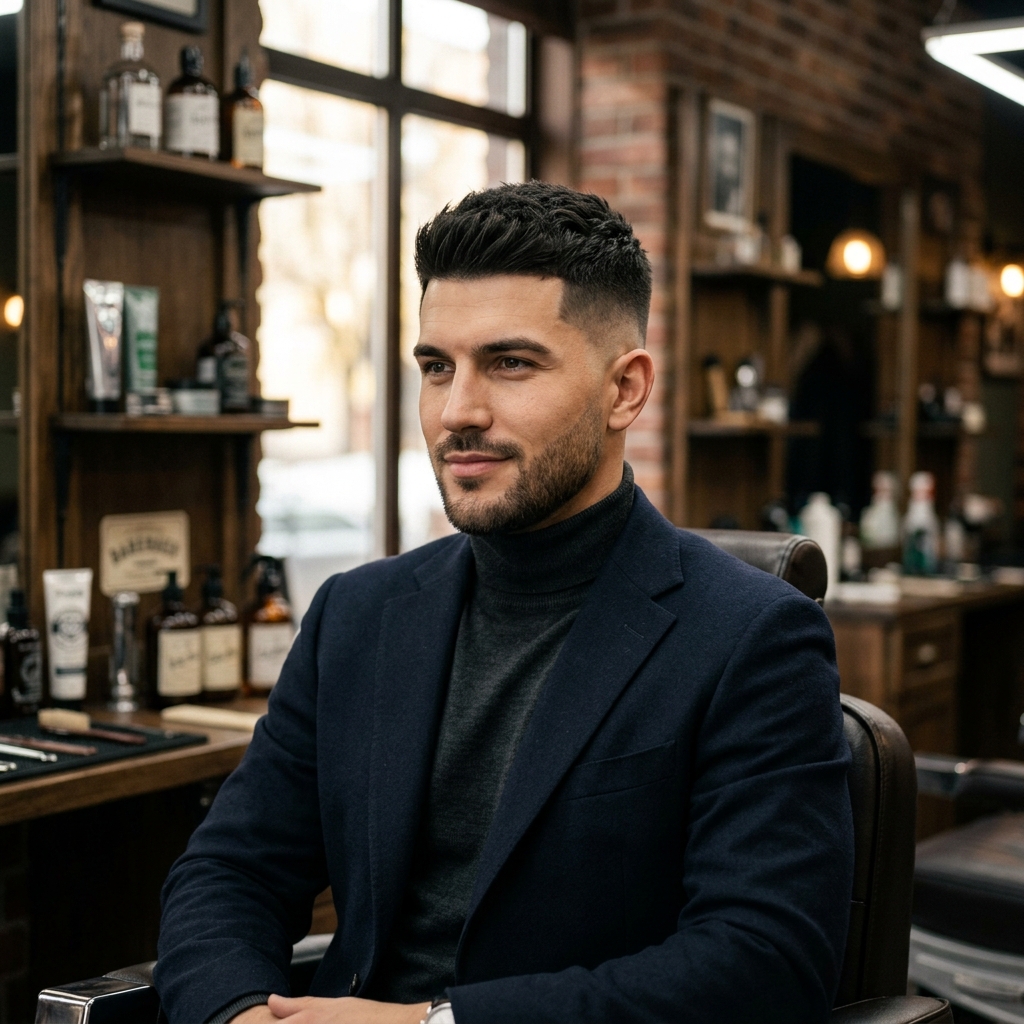
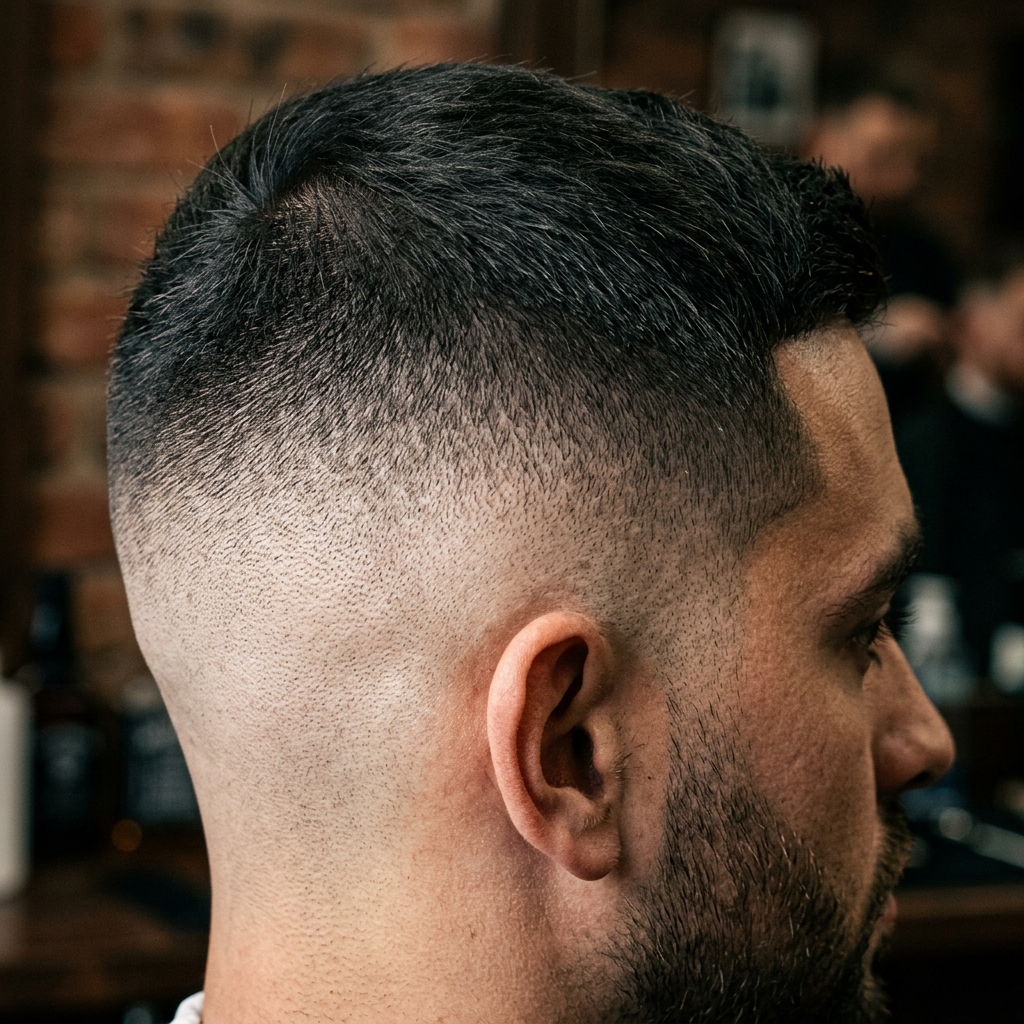
the textured crop with skin fade
This has been the dominant men’s haircut globally for several years, and it remains excellent. The sides fade to skin (or near-skin), the top section (1–2 inches) is cut with point-cutting shears to create natural movement, and a small amount of matte clay finishes it.
The universality is earned. It works across most hair textures, most face shapes, and a wide range of ages. The main limitation: it needs maintenance every 2–3 weeks or the fade looks grown-out.
the temple fade / Brooklyn fade
A shorter, more contained version of the fade focused at the temples rather than running the full sides of the head. Common in Latin barbering traditions. Creates clean lines at the front hairline while maintaining more volume through the sides.
the drop fade with textured top
The fade curves down behind the ear rather than running in a straight horizontal line. The curved transition looks more natural and dynamic, particularly when paired with natural texture or waves on top.
the low taper with short side part
A low taper (not a full skin fade—the taper begins closer to the natural hairline) with a clean side part on top. 1.5–2 inches of length on the top section, combed to one side with a medium-hold pomade. This is the professional workhorse—appropriate for most workplace environments and formal occasions.
slightly longer short cuts (1.5–2.5 inches)
the quiff
Hair combed forward and upward at the front, creating lift and volume. The quiff is the short haircut with the most personality—it’s immediately distinctive and photographs well.
Requires a moderate amount of product (medium-hold pomade or clay) applied after blow-drying or applying to damp hair. The height of the quiff determines the register—very high is more theatrical; low and relaxed is more wearable.
the textured fringe
A front section that falls forward (rather than being swept back or to the side) with natural texture. Pairs naturally with a mid or high fade at the sides. Works best with hair that has some natural movement—very straight, fine hair may need more product.
the modern pompadour
A scaled-down version of the classic 1950s pompadour. Less volume, less height than the original. The hair sweeps back and upward from the forehead with a peak. Medium-hold water-based pomade or a strong cream provides the structure.
the ivy league / Princeton
A side-parted, slightly longer short cut (2–3 inches on top) that can be combed to one side. The formal cousin of the crew cut—professional, versatile, and appropriate for every environment from board meetings to weddings.
the French crop
A blunt, slightly forward-brushed fringe with faded or tapered sides. The fringe sits horizontally across the forehead at eyebrow level or slightly above. The overall shape is clean and geometric.
Works particularly well with straight or slightly wavy hair. With a matte clay finish, it reads as modern and deliberate.
short cuts by hair type
Fine, straight hair:
Fine hair loses volume quickly and can look thin at medium lengths. Very short cuts (crew cut, buzz, tight crop) actually flatter fine hair because there’s less opportunity for it to look limp. A very small amount of volumizing mousse or texturizing spray before blow-drying adds the appearance of density.
Thick, straight hair:
Everything works. The main issue is bulk—thick hair can look heavy or rounded without proper thinning. Ask your barber to point-cut the top section and thin through the sides. This distributes the volume more evenly.
Wavy hair:
The textured crop was essentially designed for this hair type. The natural wave adds visual interest and definition that straight hair needs product to replicate. A light matte paste on slightly damp hair, air-dried, looks excellent at the 1–2 inch length range.
Naturally curly hair (type 3):
A curly crop with a skin fade—where the curls are retained on top above a clean fade—is one of the best short cuts available. The curls provide texture and dimension without any styling effort.
Tightly coiled hair (type 4):
Very short cuts work particularly well—the coil pattern creates its own geometric texture at close lengths. A very tight skin fade with a clean lineup creates a precise, deliberate aesthetic at short lengths.
Receding hairline:
Short cuts often work better with receding hairlines than longer cuts that try to conceal. A skin fade at the temples makes a slight recession look intentional rather than unfortunate. A crew cut or tight textured crop normalizes the look without trying to hide it.
what to tell your barber
Be specific. Vague language produces unpredictable results. The specific information your barber needs:
- Clipper guard number for the sides (e.g., “#1.5 on the sides”)
- Type of taper or fade (low taper, mid fade, skin fade)
- Length on top in inches (e.g., “about an inch and a half on top”)
- How you want the top finished (flat, natural curve, textured, parted)
- A reference photo if possible
The reference photo is genuinely the most useful tool. It eliminates every ambiguity in the verbal description and gives the barber something concrete to replicate.
product guide for short hair
For very short cuts (buzz, crew): None needed, or a tiny amount of skin moisturizer on the scalp.
For textured crops: A small amount of matte clay or paste (hazelnut-size). Apply to damp hair, work through with fingers.
For side parts and ivy league cuts: A water-based pomade (pea-size). Comb through after applying for a neat, defined finish.
For quiffs and pompadours: Medium-hold clay or pomade. Apply to damp hair, blow-dry with a round brush to create lift, then set with a small amount of additional product.
maintenance reality
The shorter the cut, the more frequently it needs maintenance:
- Skin fade / buzz: every 2–3 weeks
- Textured crop / crew cut: every 3–4 weeks
- Short ivy league / French crop: every 4–5 weeks
Build this schedule into the cost calculation. A very short cut that requires 2-week touch-ups ends up costing more annually than a medium-length cut that holds its shape for 5–6 weeks.
Short hair doesn’t mean simple or thoughtless. The best short haircuts are the result of precise decisions about length, fade type, finish, and product—made in advance and executed consistently. Find the right short cut for your face and hair type, tell the barber exactly what you want, and maintain it properly. That’s genuinely all there is to it.